Triple is the correct spelling. Tripple isn’t a standard English word. It’s a typo for triple, which means threefold, three times as much, or a hit that reaches third base.
Below, you’ll see why the extra p sneaks in, where triple shows up in daily English, and how it differs from treble. A quick test, a comparison table, and a short practice set round things out.
Quick Answer
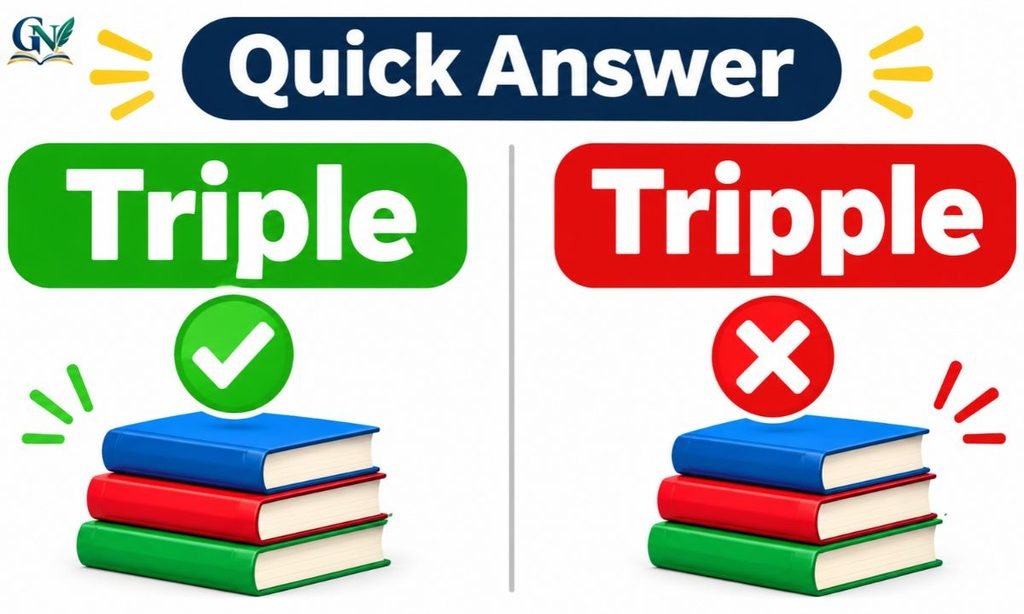
Triple has one p. That’s the only standard spelling in English. Tripple is a misspelling. The rule follows the word through every form: triples, tripled, and tripling all keep a single p.
Here’s a fast test. Triple belongs to the same family as quadruple, quintuple, and multiple. None of those words has a double p, so triple doesn’t either.
What Does “Triple” Mean?
Triple means made of three parts, or three times as large. It’s the word you reach for when something has three layers, three members, or three times the usual amount.
The word works in four roles. As an adjective, it describes things such as a triple scoop or a triple shot. As a noun, it can mean a group of three, or in baseball, a hit that lets the batter reach third base. As a verb, it means to multiply by three, as in “Rents tripled after the factory opened.”
One more role matters in sports. A batter who hits a triple has “tripled,” and a runner can be tripled home. That usage stays inside baseball talk.
Triple vs Tripple Meaning
The two spellings don’t differ in meaning, because only one of them is a real word. Tripple is what appears when a writer means triple and adds a letter.
That makes this unlike pairs such as affect and effect, where each word does a different job. Here, the choice is simply right or wrong. If you meant “three times,” the answer is triple every time.
Triple vs Tripple Examples
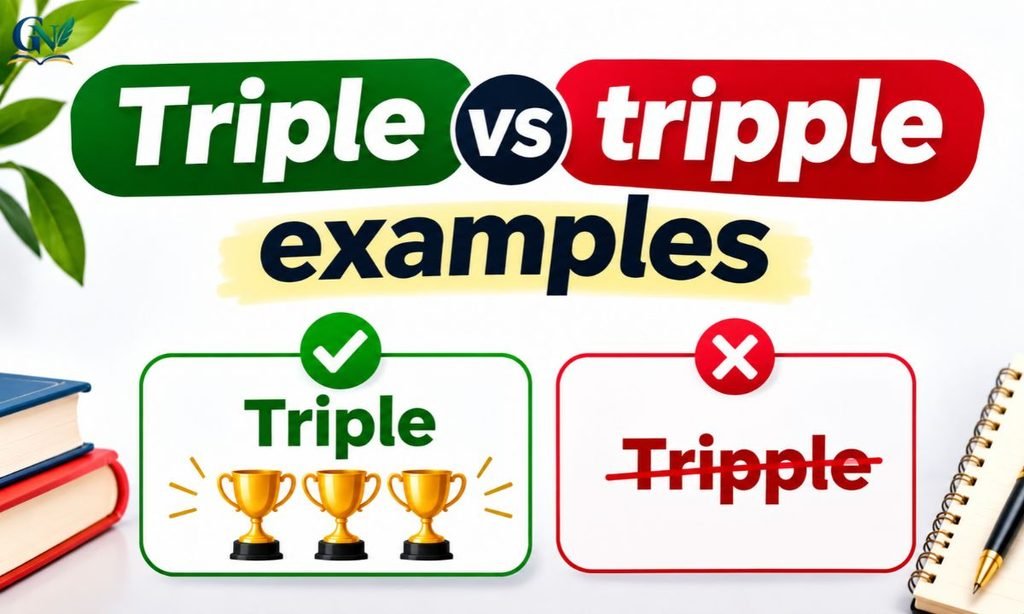
Each pair below shows the same sentence twice. Only the spelling changes.
| Incorrect | Correct |
| She ordered a tripple chocolate sundae. | She ordered a triple chocolate sundae. |
| The shop’s profits trippled last spring. | The shop’s profits tripled last spring. |
| He hit a tripple in the ninth inning. | He hit a triple in the ninth inning. |
| Prices are trippling across the region. | Prices are tripling across the region. |
Triple vs Tripple Reddit
Online, tripple appears mostly as a typo that someone corrects. Software projects show this clearly, because a misspelled variable name can spread through an entire codebase before anyone notices.
Casual forum talk about the word rarely turns into a real debate. Spelling slips of this kind get fixed quickly. The fix is always the same: drop one p.
Tripple, The Incorrect Variant
People add the second p because English trains them to. Words like ripple, apple, and tipple double the p before the ending le. After enough of them, doubling feels natural.
Triple breaks that pattern. It follows its Latin family instead, along with quadruple, quintuple, and multiple. That’s why spellcheckers flag tripple but writers still produce it so often. Another trap is Triple Sec, the orange liqueur. Some people confuse it with tipple, a word for a drink, which does carry two p’s.
Origin and Etymology
Triple comes from the Latin word triplus, meaning threefold. Etymology references build that Latin word from tri, meaning three, plus a suffix meaning fold. English took it in as an adjective in the late 12th century, either through Old French triple or straight from Latin.
Treble has the same source with a different route. It came through Old French treble, which also grew from triplus. Linguists call two such words doublets. The musical sense of treble, meaning the highest part in harmony, dates to the mid 15th century.
Nothing in this history supports a double p. The spelling has stayed single since the word first appeared.
How to Use Triple Correctly
Place triple before a noun when you want to describe it. “A triple layer of foil” and “a triple bypass of the usual route” both work. For multiplication, put it before the thing being multiplied: “triple the budget,” “triple the speed.”
Use the noun form for a set of three or a baseball hit. “The pitcher gave up a triple.” Use the verb form for growth. “Her following tripled in a month.” Keep the p single in every case.
Common Confusions
Several similar looking words cause real mix ups. Each one has its own meaning.
- Triplet: One of three children born together, or three notes played in the time of two.
- Triplicate: Three identical copies, as in “submit the form in triplicate.”
- Tripel: A Belgian style of strong pale ale. The spelling is deliberate and correct in that setting.
- Tipple: To drink alcohol regularly, or the drink itself. It has two p’s and nothing to do with the number three.
- Treble: A near synonym for threefold, covered in the table below.
Triple in Specific Contexts
Triple shifts slightly depending on where you meet it.
- Baseball: A triple is a hit that gets the batter to third base. A triple play is three outs on one play.
- Track and field: The triple jump combines a hop, a step, and a jump.
- Horse racing: The Triple Crown is a set of three major races won by one horse.
- Music: Triple meter has three beats per bar, like a waltz.
- Food and drink: A triple shot of espresso holds three shots. Triple Sec is a type of orange liqueur.
- Programming: Triple quotes mark multiline strings in Python.
Synonyms and Related Words
Threefold is the closest plain synonym. Treble works in British English and in musical settings. Triplicate fits documents and records. Thrice is an dated adverb meaning three times, so it suits poetry and playful writing more than business emails.
Related words include triplet, trio, triad, and tripling. They share the Latin root but point to groups or processes rather than the amount itself.
Pronunciation and Grammar
Triple is pronounced TRIP ul, with stress on the first syllable. The IPA form is /ˈtrɪpəl/.
It works as an adjective, noun, and verb. The forms are triple, triples, tripled, and tripling. Spellings like trippled or trippling are errors. Capitalize it only when it sits inside a proper name, such as the Triple Crown.
Common Spelling Mistakes
These errors turn up most often:
- tripple for triple
- trippled for tripled
- trippling for tripling
- tripples for triples
- tripplet for triplet
Transpositions such as tirple also happen when typing fast. The fix for the double p errors is the same each time: remove the extra p.
Practical Examples in Sentences
- The bakery tripled its weekend orders after one viral video.
- A triple espresso kept him awake through the night shift.
- Her dad cheered when the runner legged out a triple.
- The recipe calls for triple the garlic, which sounds brave.
- Ask the clerk to print the contract in triplicate.
- The Triple Crown has eluded many strong horses.
- If sales triple again, you’ll need a bigger warehouse.
- The band switched to triple meter for the final verse.
Tips to Avoid Spelling Mistakes
- Split the word. Break it into tri and ple. The p belongs to ple and sits there alone.
- Use the family. Say quadruple and multiple in your head. Neither doubles the p.
- Search your draft. Use Find for tripl and scan each hit. This catches errors that autocorrect misses.
- Check code separately. Spellcheckers often skip variable names. Run a projectwide search for tripple.
- Slow down on endings. Errors cluster in tripled and tripling, where the extra letter feels natural.
Comparison: Triple vs Tripple vs Treble
| Word | Status | Main meaning | Typical use | Example |
| Triple | Standard | Threefold; three times as much; a baseball hit | Common in US and UK English | Triple the amount |
| Tripple | Misspelling | None in standard English | Appears as a typo | Not used |
| Treble | Standard | Threefold; also the highest voice or pitch | Common in British English for amounts; used everywhere in music | A treble clef |
In American English, triple is the usual choice for amounts. Treble still shows up for sound, as in treble clef or a high pitched voice, and in British sports talk, where a club that wins three trophies in a season has won the treble.
Key Takeaways
- Triple has one p. Tripple is a typo.
- Tripple has no separate meaning in standard English.
- The same rule covers tripled, tripling, and triples.
- Triple and treble come from the same Latin word, triplus.
- Triple fits most contexts. Treble leans British or musical.
- A quick check: if quadruple and multiple have one p, so does triple.
Practice Session
Choose the correct spelling in each sentence.
- Her savings (tripled / trippled) in five years.
- He ordered a (triple / tripple) scoop of gelato.
- The batter hit a (tripple / triple) to deep center.
- Costs are (tripling / trippling) every quarter.
- Please send the report in (triplicate / tripplicate).
Answers: 1. tripled. 2. triple. 3. triple. 4. tripling. 5. triplicate.
Also Read More Grammar Guide:
Parents’ vs Parent’s: Common Mistakes and Correct Usage 2026
Across or Accross: Correct Spelling and Meaning Explained 2026
Ladel vs Ladle: Correct Spelling and Examples Explained 2026
Emersion vs Immersion: Meaning, Differences & Examples (2026)
Conclusion
Triple is the spelling to use, every time, in every form. The extra p in tripple has no basis in meaning or history. It comes from habit, borrowed from words like ripple and tipple.
Keep the family in mind: quadruple, quintuple, multiple. When the pattern is clear, the spelling stops being a coin toss.
FAQs
Is it triple or tripple?
Triple is correct. Tripple is a misspelling that no standard dictionary accepts as a variant.
How do you spell the past tense of triple?
The past tense is tripled, with a single p. Trippled is incorrect.
What is the difference between triple and treble?
Both mean threefold. Triple is the usual choice in American English, while treble is common in British English and in music for the highest voice or pitch.
Why do people spell triple with two p’s?
Words like ripple, apple, and tipple double the p before le, and that pattern gets applied to triple by habit.
Does tripple ever mean anything?
Rarely. Older dictionaries reportedly record it as a horse’s gait, and Scottish dialect has related forms, but none is a standard spelling of triple.

Abdul Rehman is a grammar enthusiast and content writer at Grammarnesty, dedicated to making English grammar, punctuation, sentence structure, and writing skills easy to understand.