
Emersion means rising out of something, such as water or an eclipse shadow. Immersion means going into something, whether that’s a liquid or a deep activity. One word points out. The other points in.
This guide shows where each word belongs. You’ll get the science uses, the psychology angle, language learning, and the kitchen tool behind most of the typos.
Quick Answer
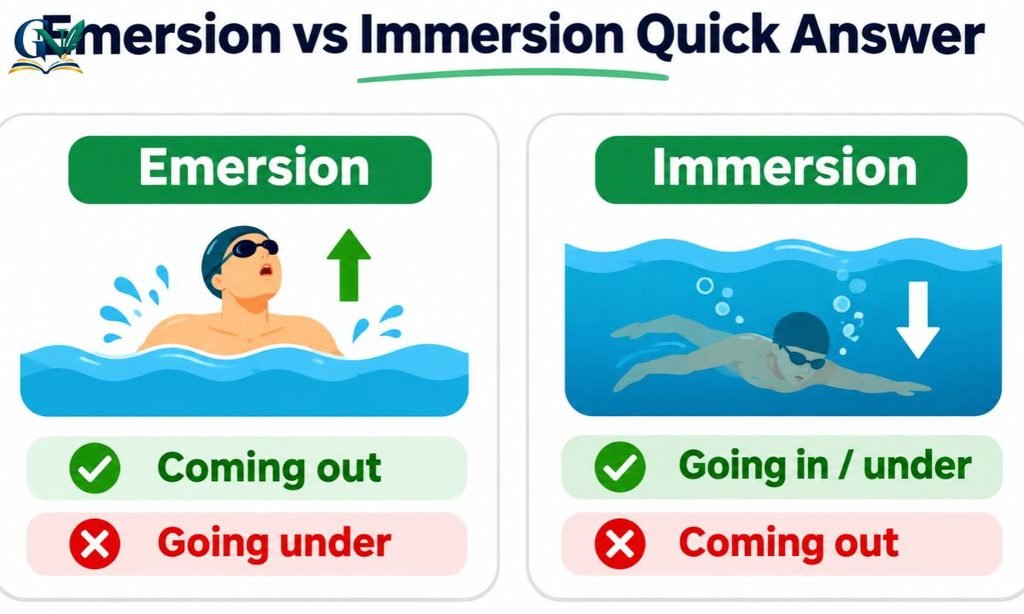
Emersion is the act of emerging, especially from water or from an eclipse or occultation. Immersion is the act of plunging into something or being deeply absorbed in it. Both words trace back to the Latin root mergere, meaning “to dip.” The prefix sets the direction: e- means out and im- means in.
Emersion vs Immersion A Quick Comparison
Here’s how the two nouns stack up side by side.
| Feature | Emersion | Immersion |
| Direction | Out, up, back into view | In, down, deep inside |
| Core meaning | The act of emerging | The act of being submerged or absorbed |
| Astronomy | Reappearance after an eclipse or occultation (also called egress) | Disappearance into an eclipse or another body’s shadow |
| Everyday use | Rare | Very common |
| Typical settings | Science, nature writing, formal prose | Language learning, VR, baptism, cooking, travel |
| Sample sentence | The diver’s emersion drew a cheer. | Her immersion in the book was total. |
Immersion shows up far more often in everyday writing. Emersion lives mostly in technical and literary corners.
Emersion vs Immersion Psychology

Emersion isn’t a formal term in psychology. Immersion is.
Psychologists and game researchers use immersion to describe deep absorption in an activity or a virtual world. If you read “emersion” in a psychology context, it’s usually a typo for immersion or an informal way to say someone is coming out of that absorbed state. The fuller story sits in a later section.
Emersion vs Immersion Quiz
Try these five. Pick the right word before you read the answer.
- The whale’s slow ______ from the bay thrilled the tour group.
- Studying abroad gave him full language ______.
- Astronomers timed the moon’s ______ from Earth’s shadow.
- A soup-friendly ______ blender lives in many kitchens.
- After the tide dropped, the barnacles faced hours of ______ in dry air.
Answers: 1. emersion. 2. immersion. 3. emersion. 4. immersion. 5. emersion.
Missed one? Ask a simple question. Is something going in or coming out? In means immersion. Out means emersion.
Emersion vs Immersion Examples
Short sentences make the split obvious.
Emersion
- The submarine’s emersion startled the sailors on deck.
- Jupiter’s moon showed its emersion a few minutes after the eclipse ended.
- The diver’s emersion from the quarry water came after three minutes.
Immersion
- Total immersion helped her pick up Spanish in months.
- The baptism included full immersion in the river.
- His immersion in the game ran past midnight.
The later examples section tests what happens when you swap the words.
Emersion vs Immersion Blender
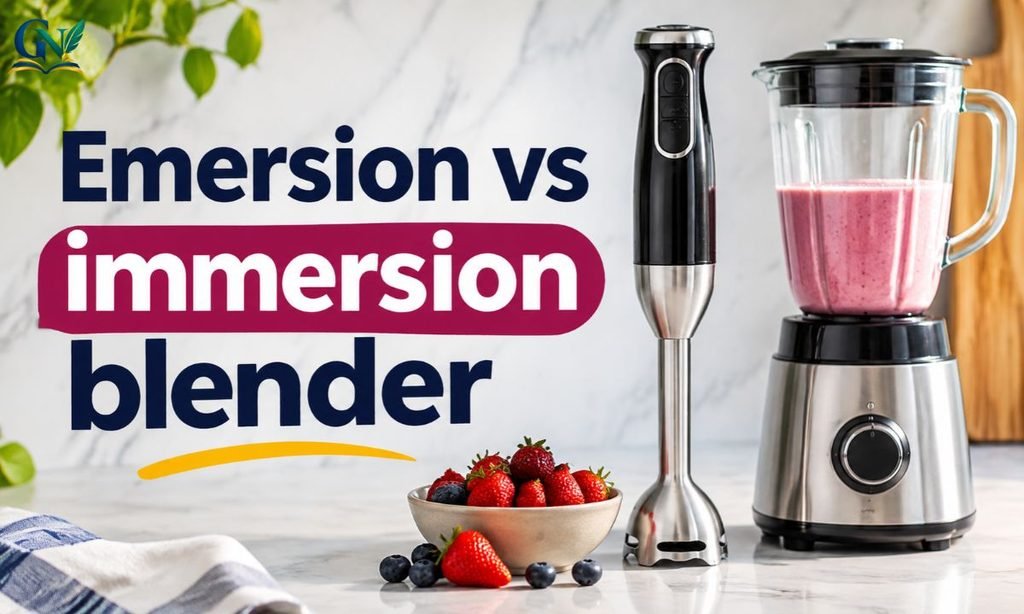
The correct name is immersion blender. “Emersion blender” is a misspelling, and no appliance goes by that name.
An immersion blender is a handheld stick with a motor on top and a blade at the bottom. You lower the blade into the pot, so the blade is immersed in the food. That’s the whole reason for the name.
Compared with a countertop blender, it’s smaller and easier to clean. It also has less power. Most models handle soups, sauces and light smoothies well but struggle with crushing ice.
Emersion Meaning, Definition and Scientific Context
Emersion is the act of emerging or coming out into view, most often from water. Dictionaries also list an astronomy sense: the reappearance of a celestial body after an eclipse, an occultation or a transit.
Picture a seal’s head popping above a harbor’s surface. That’s emersion in its plainest form. The word suggests something that was hidden or covered and now shows itself.
Context decides the feel. In physical settings the word is literal. In writing about careers or ideas, you may see it stretched to cover a rise from obscurity, though “emergence” is the more usual choice there.
Scientific Fields Where Emersion Is Used
Emersion appears mainly in astronomy and in studies of life along the shoreline.
- Astronomy: Emersion marks the moment a body reappears after an eclipse or occultation. Astronomers also call it egress. Early observers timed Jupiter’s moons this way.
- Marine biology: Organisms in the intertidal zone endure periods of emersion when the tide drops and exposes them to air. Sponges and barnacles that tolerate this have to handle swings in light, temperature and salinity.
- Geology: Older texts use the word for land rising out of water. Modern writers usually prefer “emergence.”
Origin and Etymology of Emersion
Emersion comes from Latin emersus, the past participle of emergere, “to rise out.” The English noun appeared in the 1630s and first described eclipses and occultations.
Emergere itself combines ex (“out”) with mergere (“to dip, sink or plunge”). Etymologists describe the underlying image as rising from a liquid through buoyancy. That image still shapes how people use the word today.
Emersion in Literature and Metaphorical Use
Writers sometimes borrow emersion for figurative scenes of rising out of trouble or hiding. Older dictionaries cite phrases like emersion from obscurity or from difficulties.
The metaphor works because the physical picture is so clear. A person coming up from a hard stretch of life resembles a swimmer breaking the surface. Still, modern prose tends to pick “emergence” or “emerging” instead, so emersion in this sense reads as formal or slightly old-fashioned.
Immersion Definition and Meaning
Immersion is the act of plunging something into a liquid or the state of being deeply involved in an activity or subject. Merriam-Webster style definitions cover both the physical and the absorbed sense.
The word has several specialized uses too:
- Baptism: Total submersion of a person in water.
- Astronomy: The obscuring of a celestial body by another or by a shadow.
- Appliances: An immersion heater warms liquid by sitting inside it.
- Cooking: An immersion blender works inside the pot.
Immersion in Technology and Digital Environments
In technology, immersion describes how fully a system or experience pulls you in. VR headsets are the clearest case because they take over your sight and hearing.
Researchers don’t agree on a single definition. Some treat immersion as a property of the technology, such as display quality and tracking accuracy. Others treat it as a person’s mental response, including absorption in a story or a challenge.
Game designers add one more distinction. Immersion is about attention, while embodiment is the feeling of being physically present in the virtual world.
Emersion vs Immersion key Differences
Three differences matter most.
Direction. Immersion moves inward. Emersion moves outward. Every other difference grows from that.
Frequency. You’ll meet immersion daily. You might meet emersion a few times a year.
Domain. Immersion covers learning, technology, travel, cooking and religion. Emersion sticks to science, nature and formal writing.
They also share a spelling trap. Both end in -mersion and both sound nearly identical in speech. Context is the only safety net when you hear them.
Emersion vs Immersion in Education
Immersion has a firm place in education. Emersion doesn’t.
Schools use immersion programs to teach a subject or language by delivering most instruction in it. Students absorb vocabulary through daily use instead of isolated drills. No recognized teaching method carries the name emersion.
Emersion vs Immersion in Language Learning
Language immersion means surrounding yourself with a language until you use it naturally. Living in a country where people speak it is the classic version.
You can build a version at home. Switch your phone settings, watch shows without subtitles and talk with native speakers online. Emersion has no technical role here, though you might say a learner finally “emerges” from the silent stage once speaking begins.
Emersion vs Immersion Psychology
Immersion in psychology centers on absorption and presence. Emersion isn’t an established concept, so treat any use of it as informal.
When people lose track of time during a game or a gripping film, researchers would call that immersion. Pulling yourself out afterward is simply the end of the state. Some casual writers call that moment emersion. It’s a handy metaphor but not a measured construct.
One useful distinction comes from VR design. A movie can hold your full attention without making you feel physically inside it. Embodiment is the stronger sense of being present, and it differs from plain immersion.
Emersion vs Immersion Examples
A swap test shows how much one letter changes.
- “The immersion of the diver took a second.” The diver went under.
- “The emersion of the diver took a second.” The diver surfaced.
- “Her immersion in the culture was gradual.” She sank deeper into local life.
- “Her emersion from the culture was gradual.” She slowly pulled away from it. This is rare and sounds stiff.
Notice how the first pair describes the same diver in opposite directions. That’s the cleanest proof that the words aren’t interchangeable.
Cultural Immersion Through Travel
Cultural immersion means living inside another culture’s daily routines instead of observing from outside. A homestay is a good example. You eat the family’s meals, follow their schedule and pick up local phrases.
Travelers often find the difference between tourism and immersion in small things. Shopping at a neighborhood market beats a souvenir shop. Taking local transport beats a private tour. Staying longer helps most of all.
Memory Trick for Emersion vs Immersion
Link the first letters to a direction. The letter I in immersion stands for “in.” The letter E in emersion stands for “exit.”
A second trick uses the root. Both words share mergere, “to dip.” Add im- and you dip in. Add e- and you come back out.
Explore More Grammar Guide:
Dysregulated vs Disregulated: Meaning, Differences & Usage (2026)
Farther vs Further: Meaning, Differences & Examples (2026)
Conclusion
Emersion and immersion are mirror images. One brings something up and out. The other takes you down and in.
In daily writing you’ll almost always want immersion, from language classes to the blender in your kitchen drawer. Save emersion for moments of rising out, like a whale surfacing or a moon leaving a shadow.
Frequently Asked Questions
Is emersion a real word?
Yes. Emersion is a standard English noun meaning the act of emerging, especially from water or an eclipse.
Are emersion and immersion opposites?
Yes. Immersion means going into something, while emersion means coming out of it.
Is it emersion blender or immersion blender?
The correct term is immersion blender. “Emersion blender” is a common misspelling.
What does emersion mean in astronomy?
It means the reappearance of a celestial body after an eclipse, occultation or transit. Astronomers also call it egress.
Does immersion only mean being underwater?
No. Immersion also means deep absorption in an activity, subject or environment, such as language immersion or virtual reality.

Abdul Rehman is a grammar enthusiast and content writer at Grammarnesty, dedicated to making English grammar, punctuation, sentence structure, and writing skills easy to understand.