
“Across” is the correct spelling. It has one “c” in the middle and two “s” letters at the end. “Accross” is a misspelling, and no major dictionary lists it as a variant.
The sections below explain why the error is so common, what the word actually means, and how it differs from “through” and “over.” You will also find a quick editing trick and a short practice set.
Quick Answer
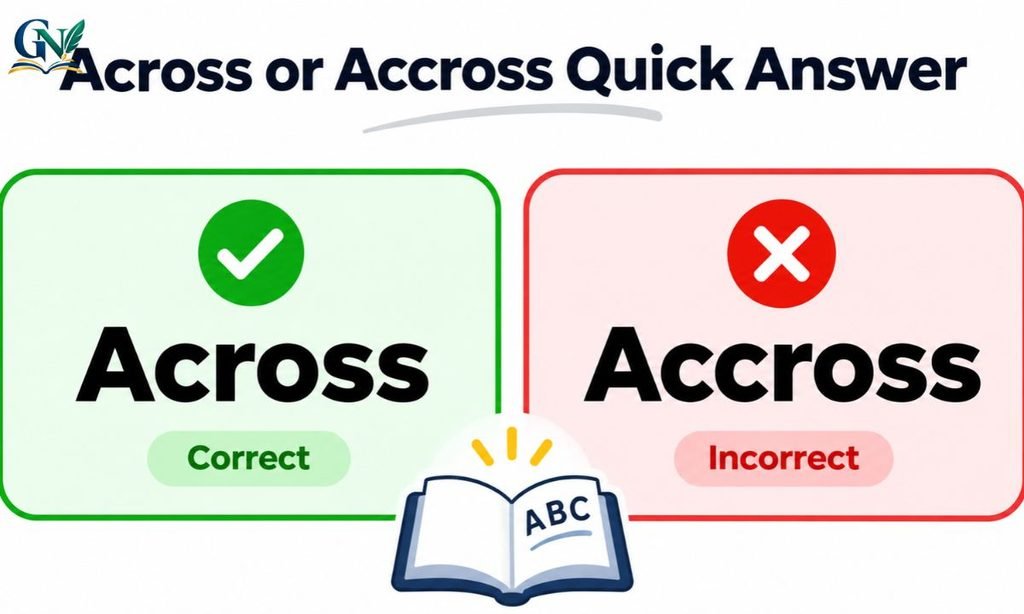
The correct spelling is “across,” with one “c.” The word means from one side of something to the other, or on the opposite side. “Accross” is never correct. To remember it, think of “a” plus “cross.” The word has the same spelling in both US and UK English.
The Correct Spelling Explained
The correct spelling is A, C, R, O, S, S. Split it into two parts: “a” plus “cross.”
That split is your best memory aid. If you can spell “cross,” you can spell “across.” Nothing in the word needs a second “c.”
Accross vs across reddit

Writers on forums such as Reddit regularly ask whether “accross” is a legitimate alternate spelling. It isn’t. The usual answer from commenters is that the doubled “c” comes from habit, not from any rule.
Spell checkers also play a role. Some basic tools and code editors have been reported to let “accross” slide, which teaches people the wrong form. A word processor with a full dictionary will flag it.
Accross vs across examples
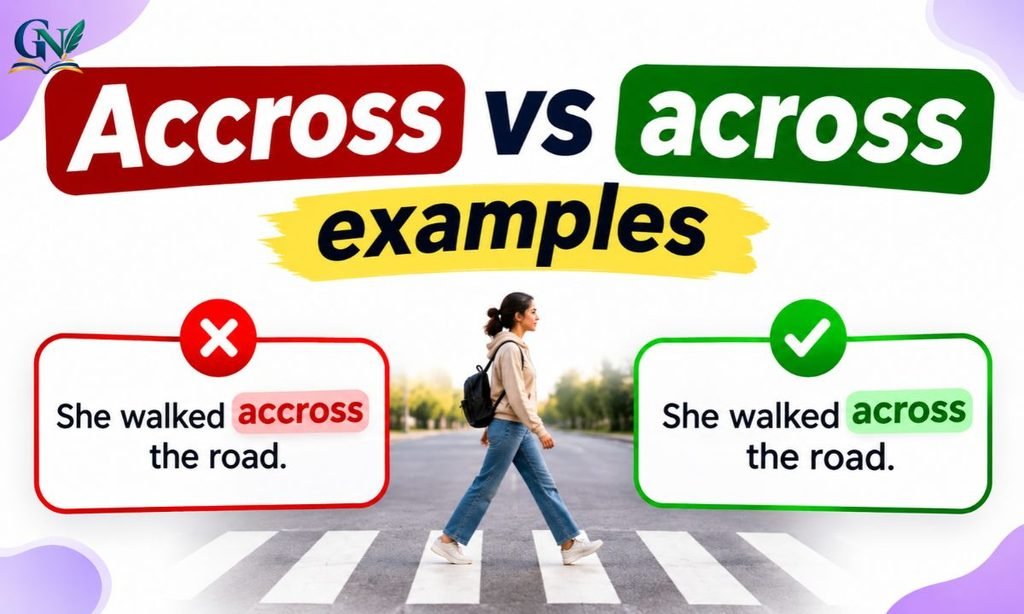
Here are paired examples. Each wrong line is followed by its fix.
- Wrong: The kids ran accross the field.
- Right: The kids ran across the field.
- Wrong: She spotted her cousin accross the street.
- Right: She spotted her cousin across the street.
- Wrong: Prices rose accross the board this spring.
- Right: Prices rose across the board this spring.
Only the spelling changes. The meaning of each sentence stays exactly the same.
Acrost vs across
“Across” is the standard form. “Acrost” is a nonstandard variant that shows up in some regional speech and in dialect writing.
It reflects how some speakers add a “t” sound at the end of the word when talking. Avoid it in articles, emails, school work, and business writing. Use it only when a character’s voice in fiction calls for it.
What Does Across Mean in English?
“Across” means from one side of something to the other side. It also means on the opposite side of something. It works as a preposition, an adverb, and occasionally an adjective in compound phrases.
As a preposition it shows movement or position. A bridge stretches across a river. A bakery sits across the road.
As an adverb it stands alone after a verb. The canyon is a mile across. Someone might walk across when the light turns green.
The word also has a figurative job. “Across the company” means in every part of the organization. “Across the board” means applying to everyone or everything in a group.
Accross vs Across Meaning Explained
“Accross” has no meaning. It isn’t a word, so there is nothing to compare. Every legitimate sense belongs to “across.”
This matters for a practical reason. When a reader meets “accross,” they understand your intent from context. They also notice the slip, and that can weaken trust in an otherwise careful piece of writing.
Why Is Across Spelled With One “C”?
“Across” has one “c” in the middle because it is built from the prefix “a” and the base word “cross.” Joining them does not double the letter.
Reference works on word history generally trace the term to an older phrase meaning “in the form of a cross.” The “a” part is a small prefix that also appears in words like “ahead,” “afloat,” and “apart.” None of those doubles the next letter either.
Compare that with words such as “accept,” “account,” and “accident.” In those, the doubled “c” belongs to a Latin prefix that changes form before certain letters. “Across” simply doesn’t come from that family.
Why Do People Spell Across Wrong?
People write “accross” mainly because many common words that start with “ac” carry a double “c.” The brain applies the pattern automatically.
Several habits feed the mistake:
- Pattern matching with words like “accommodate” and “accumulate.”
- The hard “k” sound in the middle, which feels like it needs extra support.
- Fast typing, where a finger hits “c” twice.
- Overreliance on spell check, which may or may not catch the slip.
Spelling guides that list commonly misspelled words often include this exact pair. So the confusion is widespread, not a personal failing.
Accross vs Across Grammar Rules Explained
No grammar rule governs the spelling of “across.” The issue is orthography, which is the study of correct spelling. A grammar rule would only apply to how the word works in a sentence.
In a sentence, “across” usually sits before a noun phrase. It tells you where something goes or where it is. It does not change form. You never add “-ed” or “-s” to it.
One useful point: “across” can be followed directly by a noun, as in “across the lake.” It can also be followed by “from,” as in “across from the library.” Both are standard in American English.
How to Use Across in a Sentence Correctly
Place “across” before the thing being crossed or faced. If you can replace it with “from one side to the other” or “on the opposite side of,” it fits.
Here are four natural uses:
- Movement: A fox slipped across the frozen pond.
- Position: The pharmacy is across from the post office.
- Spread: Heavy rain fell across the Midwest.
- Distance: The table measures four feet across.
A simple test helps. Ask whether something has two sides, edges, or ends. If it does, “across” probably works.
Across vs Through vs Over: Key Differences
Use “across” for a surface, “through” for an enclosed space, and “over” for passing above something. The table shows the split.
| Word | Core idea | Example |
| Across | Side to side on a surface | She walked across the parking lot. |
| Through | Inside, from one end to another | She walked through the tunnel. |
| Over | Above, or from top to top | She jumped over the puddle. |
Some overlap exists. You can fly across the ocean or over the ocean. The first stresses the distance covered. The second stresses height above the water.
A road gives another clean contrast. You drive across a bridge, through a tunnel, and over a hill.
Synonyms and Similar Words to Across
Common synonyms include “over,” “past,” “beyond,” “opposite,” and “on the other side of.” Which one fits depends on the sense you need.
- For crossing: over, past, beyond.
- For facing: opposite, facing.
- For spread: throughout, all over, widely.
- For measurement: wide, in width.
Swap with care. “Throughout” suits a wide area, such as “snow fell throughout the region.” It does not suit a single line you travel, such as “across the bridge.”
Across Spelling UK vs US: Any Difference?
No. British and American English both spell the word “across.” No regional variant uses a double “c.”
That makes it different from words like “color” and “colour,” where the two standards diverge. If you see “accross” in a British text, it is still a typo.
Is Accross Ever Correct to Use?
No. “Accross” is not correct in formal writing, casual writing, or text messages. It qualifies as an error in every standard context.
The only exceptions are intentional ones. A writer might quote someone’s misspelling to make a point, or mimic a character who can’t spell. In those cases the error is deliberate and usually flagged.
The Impact of Spelling Errors on Writing
Spelling errors distract readers and can reduce how credible a page feels. A single slip rarely ruins a piece, but repeated ones add up.
Search engines and readers both pick up on this. Clean copy signals care. A misspelled common word in a headline or first paragraph is especially costly because it appears where attention is highest.
A quick fix for this exact word: search your draft for “accross” before publishing. Many editors keep a short personal list of repeat offenders and run the same check each time.
Practice Session
Test yourself with the two short exercises below. Answers appear after each set.
Fill in the Blanks
Choose the correct spelling for each blank.
- The ferry sailed ______ the bay at dawn. (across / accross)
- Her house is just ______ the street. (across / accross)
- The new rule applies ______ all departments. (across / accross)
- The pond is about ten yards ______. (across / accross)
Answers: 1. across, 2. across, 3. across, 4. across.
Multiple Choice Questions
Question 1. Which spelling is correct?
A) accross B) acros C) across D) acrost
Question 2. Which word best fits: “The tunnel runs ______ the mountain.”
A) across B) through C) over D) beside
Question 3. What does “across the board” mean?
A) Along a wooden plank B) Applying to everyone or everything C) Near a table D) Over a deadline
Answers: Question 1 is C. Question 2 is B, because a tunnel passes inside the mountain. Question 3 is B.
Explore More Grammar Guide:
Farther vs Further: Meaning, Differences & Examples (2026)
Dysregulated vs Disregulated: Meaning, Differences & Usage (2026)
Conclusion
“Across” is the only correct form. It means from one side to the other, or on the opposite side, and it carries a single “c” because it is simply “a” plus “cross.”
Keep that split in mind and the doubled “c” stops tempting you. Add one quick search for “accross” to your final edit, and the error won’t reach your readers.
Frequently Asked Questions
Is it across or accross?
The correct spelling is “across.” “Accross” is a common misspelling.
Why does across have only one C?
It combines the prefix “a” with the word “cross,” and the joining does not double any letter.
Is acrost a real word?
It is a nonstandard, regional variant of “across.” Standard writing should use “across.”
What is the difference between across and through?
“Across” moves over a surface from side to side. “Through” moves inside something enclosed.
How can I remember the spelling of across?
Think “a plus cross.” If you can spell “cross,” add an “a” in front and you’re done.

Abdul Rehman is a grammar enthusiast and content writer at Grammarnesty, dedicated to making English grammar, punctuation, sentence structure, and writing skills easy to understand.