
Both words are correct US English, and both mean the same thing: to remove a name from a class, school, plan, or program. Disenroll is the form dictionaries list and formal documents favor. Unenroll is the plainer, more casual cousin you’ll meet on websites and school portals.
Below, you’ll see how the two differ in tone, where each one fits best, and how their noun forms behave. You’ll also get a quick test for choosing the right word, plus a few practice sentences.
Quick Answer
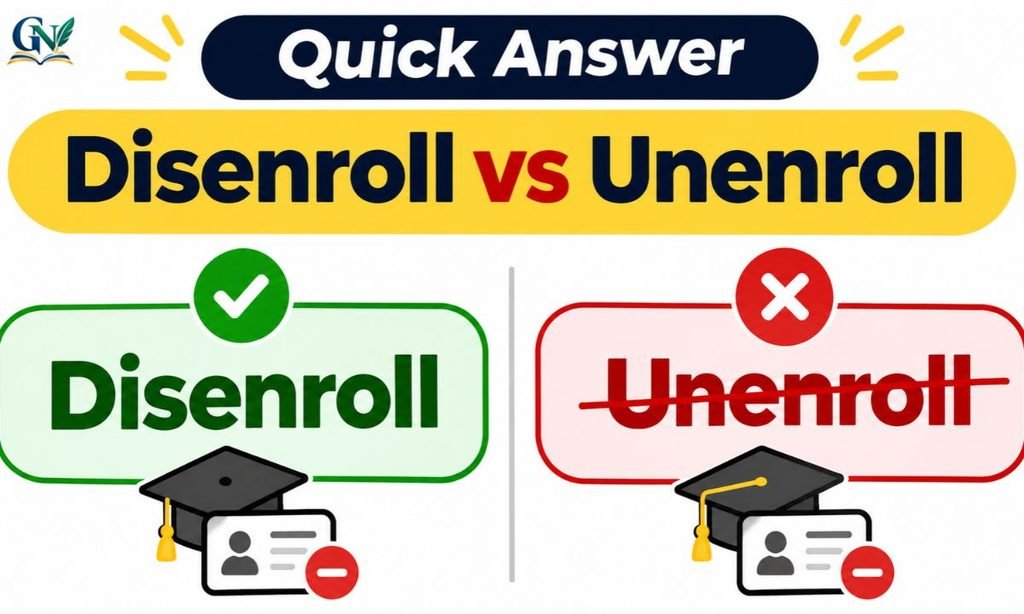
Disenroll and unenroll both mean to end an enrollment, and both keep the double l in US English. Pick disenroll for formal writing such as health plans, legal terms, and official school policy. Pick unenroll for casual or digital settings such as apps, portals, and email lists. British English usually drops one l, giving disenrol and unenrol.
The Clear, No Guesswork Answer
Neither word is a mistake. The real difference is register, which is the level of formality a word carries.
Major dictionaries such as Merriam-Webster and Dictionary.com give disenroll its own entry. Unenroll gets far less dictionary attention, yet it shows up constantly in software menus, text banking messages, and school paperwork. A 2025 memo from the Nebraska Department of Education even pairs the two words in one sentence, which tells you writers treat them as near twins.
So the safest rule is simple. Match the word to the setting, then stay consistent from start to finish.
Unenroll or Disenroll from School

Either word works for school, but disenroll sounds more official. Many schools and districts also say withdraw, which is often the cleanest choice in a formal letter.
Here’s how the three look side by side:
- “We need to disenroll our daughter before the semester ends.” (formal, administrative)
- “I unenrolled from the evening class after two weeks.” (casual, personal)
- “Please withdraw my son from Grade 5 effective Friday.” (typical office language)
Unenroll Synonym
The closest synonym for unenroll is disenroll. Other words can replace it, but each one shifts the meaning slightly.
- Withdraw: best for leaving school or a course through a formal request.
- Drop: casual and common for a single class.
- Deregister or unregister: common for courses, events, and online accounts.
- Unsubscribe: fits email lists and paid services, not schools.
Unenroll from School
To unenroll from school means your enrollment ends and your name leaves the roster. You’ll usually need to tell the registrar or main office, and many schools want that request in writing.
Policies differ from place to place. Some schools treat unenrolling and taking a leave of absence as two separate paths, and tuition deadlines can change what you owe. Check the handbook before you send the request.
What Does “Unenroll” Really Mean?

Unenroll means to remove yourself, or be removed, from something you previously joined. The prefix un reverses the action of enroll, much like undo reverses do.
You’ll see it most in digital and everyday settings. A text banking message might tell you to reply STOP to unenroll. A marketing platform might unenroll a contact from an automated workflow. Health researchers also use it when they study patients who leave a care program, such as hospice, before the end of treatment.
What Does “Disenroll” Mean?
Disenroll means to end a person’s enrollment in a school, plan, or program. Merriam-Webster traces it to the prefix dis plus enroll, and its noun form is disenrollment.
The word lives in formal territory. Medicare Advantage members disenroll when they switch back to traditional Medicare. Tribal governments use disenrollment for removing someone from a membership roll, and that usage often carries heavy legal and emotional weight. In these settings, the organization sometimes makes the decision rather than the individual.
Difference Between Unenroll and Disenroll (Deep Breakdown)
The meaning overlaps almost completely. What changes is tone, habit, and the kind of document the word appears in.
| Feature | Disenroll | Unenroll |
| Tone | Formal, official | Casual, practical |
| Typical setting | Insurance, government, legal, school policy | Apps, portals, email, classes |
| Dictionary presence | Listed by major dictionaries | Less prominent, common in real usage |
| Noun form | Disenrollment | Unenrollment |
| Who usually acts | You or an organization | Usually you |
| British spelling | Disenrol | Unenrol |
The last row of “who acts” is a tendency, not a rule. You can write that a school unenrolled a student, and plenty of people do.
Why the Noun Forms Matter
Disenrollment is the standard noun, and you’ll find it in dictionaries, insurance rules, and legal definitions. Unenrollment is real too, and it appears in school policy memos and software documentation.
The trap is mixing families. A page that tells readers to unenroll in step one and then points them to a disenrollment form in step two feels sloppy. Pick one family, then carry it through headings, buttons, and instructions.
Context Matters More Than You Think
The same action can wear different words depending on who’s reading. An insurance notice says disenroll. A school portal button might say unenroll. A tribal council uses disenrollment. A coding tutorial says unenroll a user from a course.
Think about your reader first. If a lawyer, a benefits officer, or a state agency might read the page, lean toward disenroll. If a parent, a student, or an app user will skim it on a phone, unenroll feels natural.
How to Use Unenroll in a Sentence (With Clarity)
Use unenroll when the tone is everyday and the action is simple. Here are a few examples:
- You can unenroll from the course any time before Friday.
- Maya unenrolled from the newsletter after her inbox hit 4,000 messages.
- To unenroll from text alerts, reply STOP.
- The platform will unenroll inactive learners after 90 days.
How to Use Disenroll in a Sentence (Formal Usage)
Use disenroll when the setting is official or the stakes are high. A few examples:
- Members may disenroll from the plan during the annual election period.
- The district will disenroll students who no longer live within its boundaries.
- She submitted a written request to disenroll from the university.
- The council voted on whether to disenroll 20 registered members.
Disenroll vs Unenroll Examples (Scenarios)
| Scenario | Better choice | Why |
| A health plan notice | Disenroll | Formal, regulated language |
| A “Leave this class” button | Unenroll | Short, friendly, clear |
| A school board policy | Disenroll | Official tone |
| A tutorial about user accounts | Unenroll | Technical, everyday use |
| A legal contract | Disenroll | Matches defined terms |
| A text to a friend | Unenroll | Relaxed speech |
Common Mistakes in Unenroll vs Disenroll
Most errors come from spelling or consistency, not meaning.
- Writing “disenrole” or “unenrole.” Enroll comes from the idea of entering a name on a roll, so the ending is roll with two l’s in US English.
- Mixing both words in one document. Readers may wonder whether you mean two different actions.
- Using one l in US writing. Disenrol and unenrol belong to British style.
- Choosing unenroll for a legal definition. Contracts and policies usually stick to disenroll.
- Confusing the word with “not yet enrolled.” Someone who never joined is unenrolled in the sense of being not enrolled. Someone who joined and then left has been disenrolled or has unenrolled.
One Word Changes Everything
Swap one word and the feel of the sentence shifts. “She unenrolled from the club” sounds like her own quick choice. “The club disenrolled her” sounds like a decision made by an authority.
That shift matters most when consequences are serious. Disenrollment from a health plan can change your coverage. Disenrollment from a tribal roll can change legal standing. Choose the word that fits the weight of the event.
Memory Tricks to Never Mix Them Up Again
- Dis for dismissal. Think of an office or board that formally dismisses a name from a list.
- Un for undo. Picture an undo button that reverses a sign up.
- Two l’s, one roll. Enroll puts a name on a roll, so the roll keeps both l’s.
- Formal letter test. Would this sentence fit in a letter from a government office? If yes, choose disenroll.
When to Use Disenroll vs When to Use Unenroll
Use disenroll when:
- You’re writing for insurance, government, legal, or school policy audiences.
- An organization is the one ending the enrollment.
- The document defines terms and needs formal wording.
Use unenroll when:
- You’re writing interface text, help articles, or friendly emails.
- The reader is acting on their own behalf.
- The tone is conversational.
Practice Section (Make It Stick)
Pick the better word for each sentence.
- The Medicare Advantage member chose to ______ during the open period.
- Tap the button below to ______ from this course.
- The state agency will ______ participants who miss the deadline.
- Reply STOP if you wish to ______ from alerts.
Answers: 1. disenroll. 2. unenroll. 3. disenroll. 4. unenroll.
Key Takeaways
- Disenroll and unenroll share the same core meaning.
- Disenroll sounds formal, while unenroll sounds casual and digital.
- US English uses a double l, and British English often uses one.
- Disenrollment is the standard noun, and unenrollment also appears in policy and software writing.
- Consistency inside one document matters more than the exact choice.
Explore More Grammar Guide:
Dysregulated vs Disregulated: Meaning, Differences & Usage (2026)
Farther vs Further: Meaning, Differences & Examples (2026)
Parents’ vs Parent’s: Common Mistakes and Correct Usage 2026
Final Thought
You won’t lose credibility by picking either word, as long as the tone matches the setting. Disenroll suits official paperwork, and unenroll suits quick, friendly instructions.
Treat the choice as a style decision rather than a grammar test. Decide who’s reading, choose the word that fits them, and keep it steady.
Frequently Asked Questions
Is unenroll a real word?
Yes. Unenroll is widely used in US English, especially in software and school settings, though disenroll gets more attention in dictionaries.
Are disenroll and unenroll the same thing?
They mean nearly the same thing. Disenroll sounds more formal, while unenroll sounds more casual.
Is it disenroll or disenrol?
Disenroll is the US spelling. Disenrol is the British spelling.
Is disenrollment or unenrollment correct?
Both appear in real writing. Disenrollment is the standard dictionary noun, while unenrollment shows up in policies and software.
Which word should I use on a website?
Use unenroll for friendly buttons and help text. Choose disenroll for legal or insurance pages, and keep one word throughout.

Abdul Rehman is a grammar enthusiast and content writer at Grammarnesty, dedicated to making English grammar, punctuation, sentence structure, and writing skills easy to understand.