
A signer is a person who signs something, such as a contract, a check, or a petition. A signor is an Italian title of respect for a man, much like Mr. in English. The two words look alike but share no meaning.
This page covers where each word comes from, how to use both in a sentence, and which slips get past spell checkers. A short quiz at the end lets you test yourself.
Quick Answer
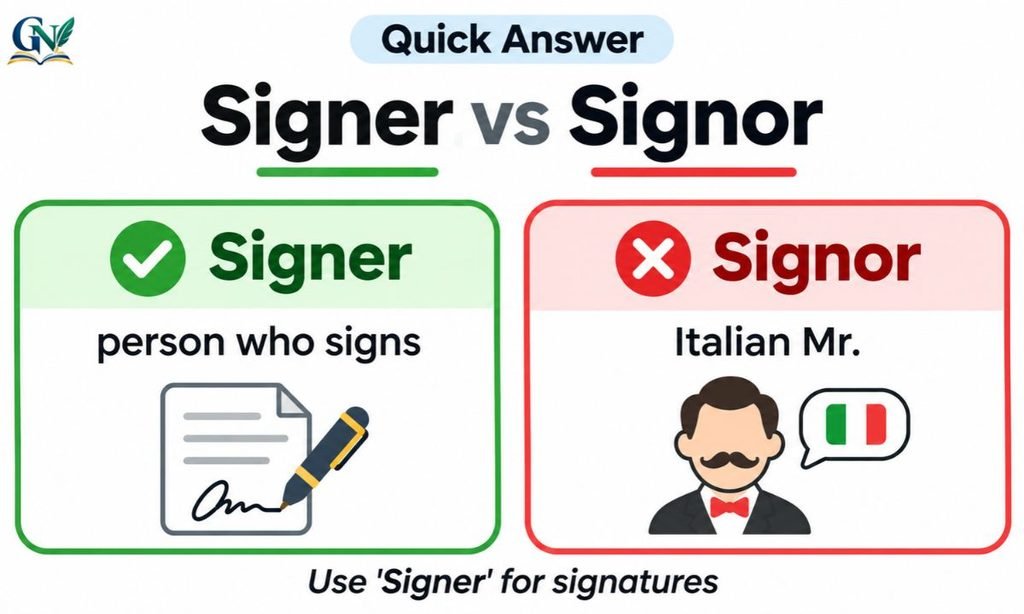
Use signer for the person who signs a document. Use signor only as an Italian courtesy title before a man’s name, as in Signor Rossi.
Try a quick swap test. Replace the word with “the person who signs.” If the sentence still works, write signer. If the word sits before a surname and means Mr., write signor.
Signer vs Signor Meaning and Origins
Signer and signor are unrelated nouns that differ by a single vowel. Their spellings overlap by chance. Their roots, sounds, and jobs in a sentence don’t.
Signer vs signor meaning
A signer is someone who signs; a signor is an Italian gentleman or the title used to address one. Signer has a second, less common sense too. It can describe a person who communicates in sign language. Signor is a shortened form of the Italian word signore, and English dictionaries record both spellings along with the older variant signior.
| Feature | Signer | Signor |
| Part of speech | Noun | Noun |
| Core meaning | Person who signs | Italian courtesy title for a man |
| Language | English | Italian, borrowed into English |
| Built from | The verb sign plus the ending er | Italian signore, with the final e dropped |
| English sound | SY ner | see NYOR |
| Plural | Signers | Signors or signori |
| Typical home | Contracts, banking, petitions, sign language | Italian names, opera, fiction, restaurants |
The origins explain why the two words never merge. Signer is built from the English verb sign plus the ending er, and sign traces back to the Latin signum, a mark. Signor reached English from Italian in the 1500s. Italian signore comes from Medieval Latin senior, meaning older or lord. That same root gave English senior, sir, and sire. The gn in signor is simply Italian spelling for the sound ny.
Signor legal definition
Signor has no legal definition because it isn’t a legal term. It’s a courtesy title.
Some web pages present signer vs signor as a legal distinction. That framing misleads. The only legal link is that signer appears in contracts, while signor appears in legal papers solely as part of an Italian man’s name. Italian paperwork usually calls the person who signs il sottoscritto, meaning the undersigned, or the firmatario, meaning the signatory. The signor in those documents is just the title, as in il signor Rossi.
Signer vs signor examples
Context decides which word fits, and a good sentence makes the choice obvious.
- Signer: Every signer must show photo ID before the notary stamps the page.
- Signer, sign language sense: The interpreter is a fluent signer.
- Signor: Signor Moretti greeted the guests at the door.
- Both together: The signer of the lease phoned Signor Moretti, the landlord.
How to Use Signer and Signor in a Sentence

Treat signer as an ordinary noun and signor as a title that travels with a name. That one habit prevents most errors.
Signer takes articles and adjectives like any common noun. You can write a signer, the second signer, or an authorized signer. Signor almost always comes before a surname and takes a capital letter in English, as in Signor Conti.
Italian speakers use the full form signore when they address a man without naming him, as in “Buongiorno, signore.” They drop the final e before a name. English borrowed both forms, so either can appear in fiction or travel writing.
Word Types and Grammatical Notes
Both words are nouns, yet they behave differently. Signer is a countable common noun with a regular plural. Signor works as a title, so it behaves more like Mr. or Dr.
Signor has two plurals in English: signors and signori. The abbreviation is Sig., and Italian writers usually keep it lowercase. The feminine forms are signora for a woman and signorina, traditionally used for a young or unmarried woman.
One extra trap sits in French. French signer is a verb meaning to sign, so it isn’t an English noun at all. English has no verb signer. The verb is simply sign.
Synonyms and Related Terms
Signer has several near synonyms. Signor has equivalents in other languages rather than true synonyms.
Related to signer:
- Signatory: more formal, and often a party or country bound by the document
- Signee: listed by some dictionaries as a synonym, though some business writers use it for the person receiving a document
- Undersigned: a formal reference to the person whose name appears at the bottom
- Cosigner: a second person who signs and shares responsibility, often on a loan
- Endorser and subscriber: close cousins with narrower uses
Related to signor:
- Mr. and sir: the closest English equivalents
- Signore and signior: spelling variants
- Señor, senhor, monsieur, and Herr: the matching titles in Spanish, Portuguese, French, and German
Antonyms and Contrasts
Neither word has a true antonym. Each does have a useful contrast.
A signer contrasts with a witness. The witness watches the signing but doesn’t sign as a party. A notary contrasts with a signer in a similar way. The notary certifies the signature without taking on the agreement.
Signor contrasts with signora, its feminine counterpart. It also contrasts with titles from other languages. Calling a Spanish man signor is a mismatch, since señor is the right title.
Legal and Financial Applications
In legal and financial work, signer is the word that matters. Banks list authorized signers on an account. Notaries refer to the signer who appears before them. Electronic signature platforms label each person who must sign as a signer.
Loans add a related role, the cosigner. A signer generally needs legal capacity, which usually means adult age and sound mind. Rules vary by jurisdiction and by document, so check the requirements for your specific form.
Signor never names a role in these documents. You may still see it as a title inside an Italian name.
Legal English does use the or ending for agents such as assignor, lessor, and mortgagor. That pattern can tempt writers to coin signor for the party who signs. Standard dictionaries record signor only as the Italian title, so signer remains the correct choice.
Historical and Cultural Context
Signor entered English from Italian in the 1500s, while signer grew from the English verb sign. Etymology sources place the first English use of signor between 1539 and the 1570s, depending on the dictionary. The feminine signora followed in the 1600s, and signorina appeared in the 1800s.
In English, signor often signals an Italian setting. You’ll meet it in opera programs, period novels, and Italian restaurants. In Italian, signore is plain everyday courtesy. The capitalized Signore can also name the Lord in religious contexts.
Signer carries its own history. The Declaration of Independence has 56 signers, and their names are still taught in American classrooms.
Famous Quotes and Examples
Shakespeare gives the best known literary use of the older spelling signior. In The Merchant of Venice, Shylock begins a famous speech with “Signior Antonio, many a time and oft.” Characters in Much Ado About Nothing also use the same title.
For signer, history offers a vivid case. John Hancock signed the Declaration of Independence so boldly that “John Hancock” became casual American slang for a signature.
A modern pair shows the contrast. “Signor Bellini, please add your signature as the second signer.” The first word is a title. The second is a role.
Common Mistakes and How to Avoid Them
The most common error is using signor where a document needs signer. Spell checkers miss it because both words are valid.
- Signor for the person signing. “The signor must initial each page” is wrong. Write signer.
- Signer as a title. “Signer Rossi” is wrong. Write Signor Rossi.
- Signor for every foreign man. Signor is Italian only. Use señor for Spanish, monsieur for French, and Herr for German.
- Missing capital letter. In English, write Signor Conti, not signor Conti.
- Treating signer and signatory as twins. Choose signatory when you mean a formal party bound by the agreement.
An editing tip helps here. Search your draft for signor. Keep it only when an Italian name follows. Change every other hit to signer.
Practice Session Signer vs Signor
Choose signer or signor for each blank, then check the answers below.
- The bank asked every ______ to confirm a home address.
- Good evening, ______ Verdi. Your table is ready.
- The ______ at the front interpreted the speech into sign language.
- A petition with 5,000 ______ landed on the mayor’s desk.
- “Thank you, ______,” the waiter told the elderly Italian guest.
- The ______ forgot to date the lease.
Answers: 1. signer. 2. Signor. 3. signer. 4. signers. 5. signor (signore also works). 6. signer.
Key Takeaways
- A signer is a person who signs, and the word can also mean a sign language user.
- A signor is an Italian courtesy title for a man, and signora is the feminine form.
- The roots differ: signer comes from Latin signum, signor from Latin senior.
- Signor has no legal meaning, so contracts need signer or signatory.
- The swap test works: if “the person who signs” fits, write signer.
Explore More Grammar Guide:
Dysregulated vs Disregulated: Meaning, Differences & Usage (2026)
Farther vs Further: Meaning, Differences & Examples (2026)
Conclusion
Signer names a person who performs an action. Signor names a courtesy owed to an Italian gentleman. One belongs on the signature line, and the other belongs before a surname.
When a draft makes you pause, run the swap test and look for an Italian name nearby. That check settles the choice in seconds.
FAQs
Is signor a real English word?
Yes. English dictionaries list signor as a borrowed Italian title for a man, equal to Mr.
Can signor mean the person who signs a document?
No. The standard word is signer. Signor works only as an Italian title before a name.
How do you pronounce signer and signor?
Signer sounds like SY ner, with a silent g. Signor sounds like see NYOR, close to the Italian pronunciation.
What is the female version of signor?
The female version is signora. Signorina is the traditional form for a young or unmarried woman.
What is the difference between a signer and a signatory?
A signer is anyone who signs. A signatory is usually a formal party, such as a person or country, bound by the document.

Abdul Rehman is a grammar enthusiast and content writer at Grammarnesty, dedicated to making English grammar, punctuation, sentence structure, and writing skills easy to understand.