
Use parents’ when something belongs to two or more parents. Use parent’s when it belongs to one. Plain parents, with no apostrophe, simply means more than one parent.
Here you’ll find a quick test for picking the right form, real examples from forms and school notices, the slips writers make most often, and a short practice set with answers.
Quick Answer parents vs parent’s
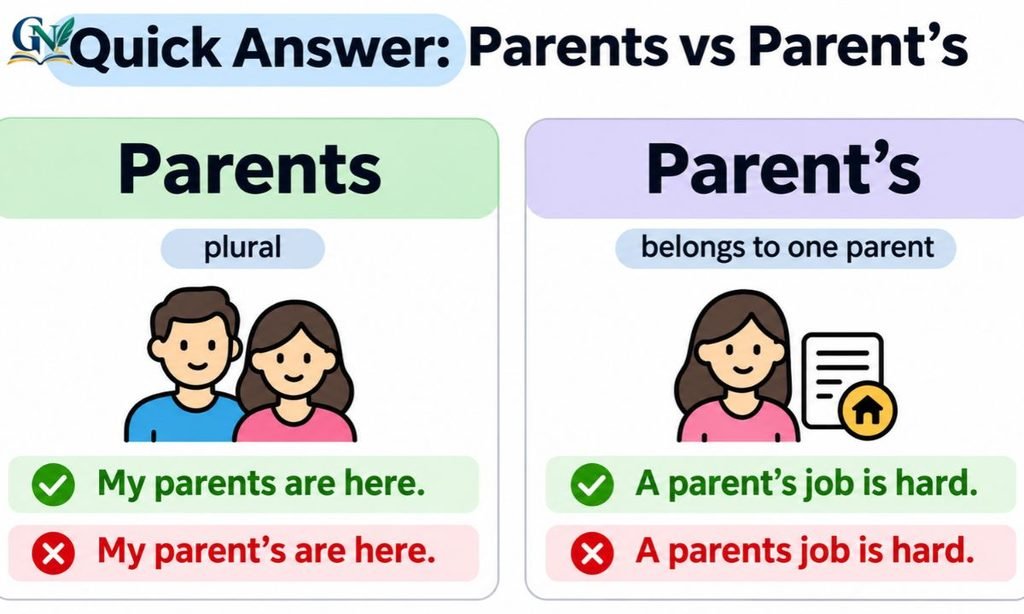
Parent’s is the singular possessive, parents’ is the plural possessive, and parents is the plain plural with no ownership at all. Count the owners and the right form follows.
| Form | What it is | Owners | Example |
| parents | Plural noun | None | Her parents moved to Texas last spring. |
| parent’s | Singular possessive | One parent | Her parent’s old truck still runs. |
| parents’ | Plural possessive | Two or more parents | Her parents’ garden wins prizes every summer. |
One owner means parent’s. Several owners mean parents’. No owner means no apostrophe.
Parents vs parent’s reddit
Reddit threads on this topic keep landing on the same answer: the apostrophe sits right after the owner word. One recent r/grammar poster said they’d rarely seen the plural form in print. Replies confirmed that parents’ is the standard choice for a plural owner.
The confusion makes sense. Parent’s and parents’ sound identical when spoken, so only the spelling carries the difference. Forum advice works as a sanity check. For anything formal, trust a style guide over a comment thread.
Parents vs parent’s meaning
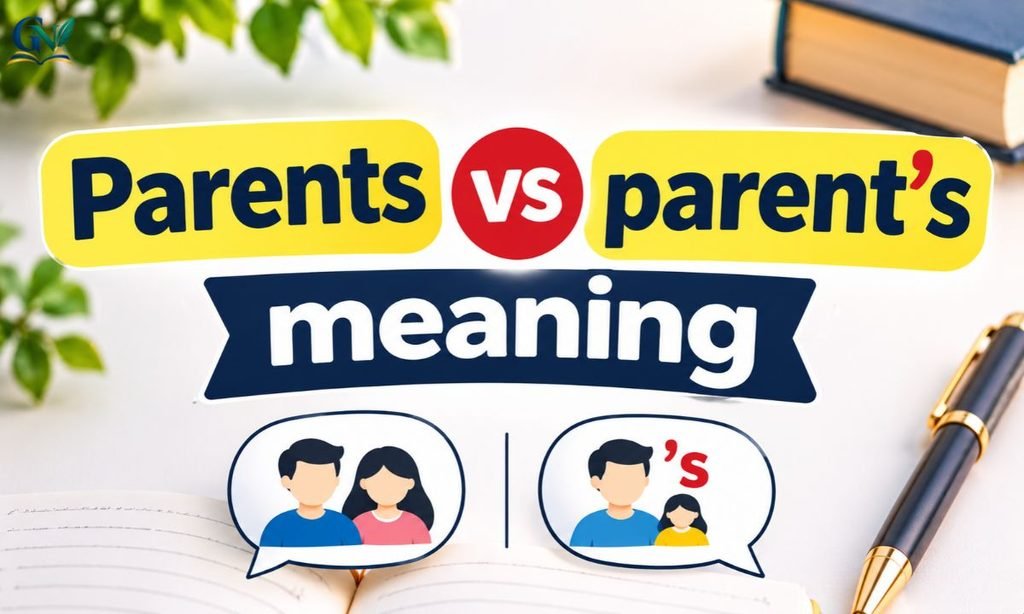
Parents means more than one mother, father, or guardian. Parent’s means something belonging to one of them. Parents’ means something belonging to several.
The base word, parent, names a person raising a child. Add an s and you’ve got a plural. Add an apostrophe and you’ve got ownership. Both marks can appear together, which is exactly what happens in parents’.
Parents vs parent’s examples
Small changes in punctuation change who owns what. These pairs show how:
- My parent’s car broke down. (One parent owns the car.)
- My parents’ car broke down. (The car belongs to both, or to the couple.)
- My parents drive a red car. (No ownership, just a plural subject.)
- A parent’s worry never really ends. (Any single parent.)
- Parents’ worries tend to change as kids grow. (Parents as a group.)
Read each one aloud and you can’t hear a difference. Written down, the meaning is obvious.
Parents vs parent’s grammar
Both forms are nouns in the possessive case, and each one modifies the noun that follows it. In “parent’s signature,” the word parent’s tells you whose signature.
Singular nouns take an apostrophe plus s. Plural nouns that already end in s take only the apostrophe. That’s why standard style guides write parents’ and not parents’s. Irregular plurals such as children behave differently, because they don’t end in s. They take the full ending, as in children’s.
What Do Parent’s and Parents’ Actually Mean?
Both show that something belongs to a parent or parents. The only difference is how many people hold it.
Grammar stretches “belonging” well past objects. A parent’s permission, a parent’s patience, and the parents’ approval all use the same form. Relationships, feelings, and events qualify as owned things too.
The Core Grammar Rule Behind Apostrophes
Name the owner first, then attach the apostrophe, and add an s only if the word doesn’t already end in one. Three steps make this automatic:
- Find the owner. Is it one parent or several?
- Write the owner exactly as it appears: parent or parents.
- Add ’s to a singular word, or just ’ to a plural ending in s.
You can double check with an “of” test. Flip the phrase: “the house of my parents” becomes my parents’ house. If the owner in the flipped version is plural, the apostrophe goes after the s.
Parents’ vs Parent’s vs Parents in Real Life
In everyday writing, three questions settle the choice: how many people, do they own something, and is a noun coming next? If the answer to the second question is no, skip the apostrophe.
Think of three ordinary situations. A card reading “To my parents” needs no apostrophe. A text that says “Your parents’ flight lands at nine” does. A note about “a parent’s duty” refers to one person in a general way. Notice how often the word after the owner is a noun, such as flight or duty. That’s your cue.
Parents Meeting or Parents’ Meeting (School Context Explained)
Both spellings appear on school websites, but parents’ meeting is the traditional and more precise form. The apostrophe tells readers the meeting belongs to the parents as a group.
Some schools drop the mark and treat parents as a label, much like “teachers lounge.” That style is acceptable when applied consistently. Parent’s meeting only fits when a single parent is involved. Many US schools sidestep the question with phrases like parent teacher conference.
Parents’ Name, Parent’s Name, and Signature Usage
On a form with space for one adult, write Parent’s Name or Parent’s Signature. When the form asks for two adults, write Parents’ Names or Parents’ Signatures. The apostrophe follows the owner, and the second noun can be singular or plural without changing that.
Forms often dodge the issue with Parent or Guardian Name. That wording works because it uses parent as a plain descriptor. Choose one pattern and keep it identical on every page of a packet.
Parents’ House vs Parent’s House (Ownership Clarity)
Parents’ house means a home belonging to two or more parents, usually a couple. Parent’s house means the home of one parent.
The difference can carry real information. Compare “I’m staying at my parent’s house this week” with “I’m staying at my parents’ house this week.” The first suggests one household. The second usually suggests a shared one. For families with two separate homes, a single apostrophe can answer a question the reader never had to ask.
Plural vs Possessive Nouns (Why Errors Happen)
Writers slip because plural and possessive forms sound the same and both involve an s. Many people also treat the apostrophe as a plural marker, which it almost never is.
A helpful way to see it: the final s does one job in parents and a different job in parent’s. In parents’, the word does double duty. It’s plural, because there’s more than one parent, and it’s possessive, because they own something. That double role explains why the apostrophe lands after the s and not before it.
Common Mistakes with Parents’ vs Parent’s
Most errors fall into a handful of repeat patterns. This table shows each one with its fix:
| Mistake | Correction | Why |
| Parent’s are invited to the meeting. | Parents are invited to the meeting. | A plain plural never takes an apostrophe. |
| Both parent’s signatures are needed. | Both parents’ signatures are needed. | Two owners require the plural possessive. |
| That’s my parents’s car. | That’s my parents’ car. | A plural already ending in s takes only the apostrophe. |
| Her parents’ are coming. | Her parents are coming. | No owned noun follows, so no possession exists. |
| I’m visiting my parent’s (both of them). | I’m visiting my parents’ (home). | The owners are plural, so the mark follows the s. |
Is It Parent’s or Parents’ Evening?
It’s parents’ evening. The event serves all the parents of a class or year group, so the plural possessive fits.
The phrase is common in UK schools, and school websites overwhelmingly show the apostrophe after the s. Some pages write parents evening with no mark, treating it as a label. Parent’s evening would only suit an event meant for one parent, which almost never happens.
Why Apostrophe Placement Matters
Placement tells the reader how many owners are involved. That affects whose action a form requires and what a notice actually promises.
Beyond meaning, small marks shape trust. A letter from a school or a business with a misplaced apostrophe can feel careless, even when everything else is accurate. Getting it right costs nothing.
English Writing Tips for Possessives
When you’re unsure, run one of these checks:
- Swap in a name. If “John’s house” fits, you need the singular form.
- Flip the phrase with “of.” The house of the parents is the parents’ house.
- Count the owners before you touch the apostrophe.
- Rewrite the sentence. “The car my parents share” avoids the question entirely.
Reading aloud won’t help here, since the forms sound identical. Always decide on paper.
School Communication Errors
School paperwork produces a predictable set of mistakes, mostly in headings, forms, and greetings. A few real patterns:
- A poster reading “Parent’s Evening” for an event open to every family. Fix: Parents’ Evening.
- A form line labeled “Parents Signature.” Fix: Parent’s Signature for one adult, or Parents’ Signatures for two.
- A letter that opens “Dear Parent’s.” Fix: Dear Parents.
Notice the last one. A greeting addresses the people, so it’s a plain plural and takes no apostrophe.
Practice Section
Choose parents, parent’s, or parents’ to complete each sentence.
- Both ___ signatures are needed on the permission slip.
- Her ___ are visiting from Ohio next week.
- The ___ phone number was missing from the form, since only one adult was listed.
- We cleaned our ___ garage on Saturday.
- All ___ must sign in at the front desk.
- The school hosts a ___ evening every term.
- Fix the error: “The parents’s meeting starts at six.”
Answers
- parents’. Two signatures mean two owners.
- parents. They’re visiting, not owning anything.
- parent’s. One adult is the owner.
- parents’. The garage belongs to both.
- parents. A plain plural subject.
- parents’. The evening is for all parents.
- The parents’ meeting starts at six. A plural ending in s takes only the apostrophe.
Explore More Grammar Guide:
Farther vs Further: Meaning, Differences & Examples (2026)
Dysregulated vs Disregulated: Meaning, Differences & Usage (2026)
Final Verdict
Parents is the plain plural. Parent’s covers one owner. Parents’ covers several. Count the people first and the apostrophe almost places itself.
The biggest takeaway for school and family writing is simple. Greetings and subjects use parents with no mark, while anything owned by a group of parents uses parents’. Pick one style for forms and notices and stay consistent.
Frequently Asked Questions
Is it my parent’s house or my parents’ house?
Use my parents’ house for a home both parents share. Use my parent’s house when you mean one parent’s home.
Is parents’s ever correct?
Standard style guides write parents’ with no extra s. The form parents’s appears in some informal writing but isn’t the accepted choice.
Should a form say Parent’s Signature or Parents’ Signature?
Write Parent’s Signature when one adult signs. Write Parents’ Signatures when two adults sign.
Does the plain word parents need an apostrophe?
No. When parents simply means more than one parent, with nothing owned, the word stays unmarked.
What’s the fastest way to remember the difference?
Count the owners. One owner takes ’s, several owners take s’, and no owner means no apostrophe.

Abdul Rehman is a grammar enthusiast and content writer at Grammarnesty, dedicated to making English grammar, punctuation, sentence structure, and writing skills easy to understand.


Pingback: Submission vs Submittion: Grammar Rules You Should Know 2026
Pingback: Icicle vs Icycle: Correct Spelling, Meaning & Usage (2026)