Immaculate is the correct spelling when you mean spotless, flawless or pure. “Emaculate” is a misspelling in modern English, though it has a surprising past.
Below, you’ll see what each form means, how to say the right one and how to use it. You’ll also get a simple trick that keeps the spelling straight.
Quick Answer?
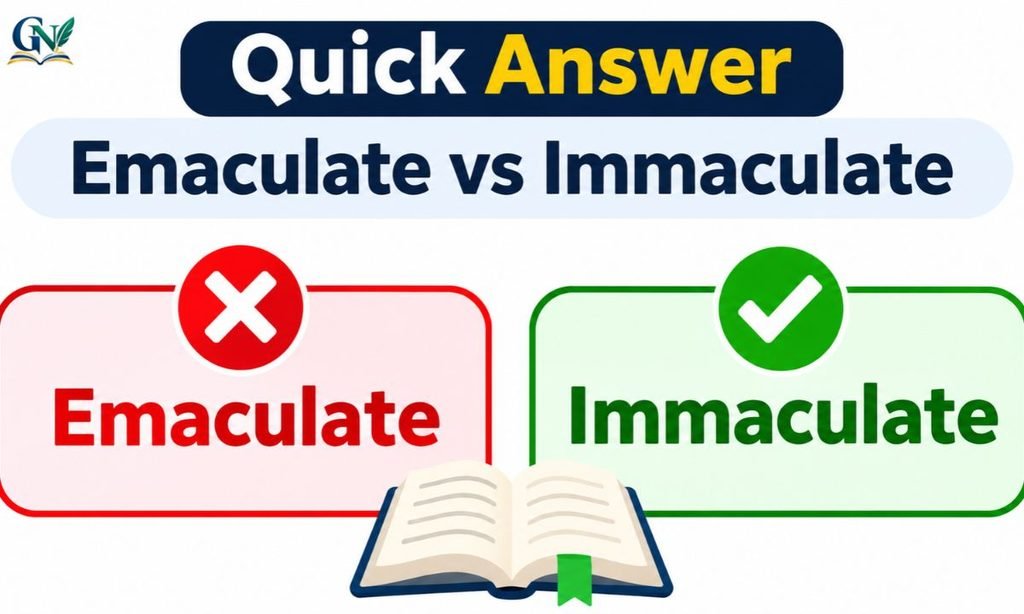
Write immaculate, with an I at the start and a double M. Use it for a spotless room, a flawless record or moral purity.
| Spelling | Status today | Should you use it? |
| Immaculate | Standard adjective | Yes |
| Emaculate | Obsolete verb, usually a typo | No |
Immaculate Meaning: What Does It Actually Mean?
Immaculate means perfectly clean or completely free from fault. It’s stronger than “clean” because it suggests you couldn’t find a single mark or mistake.
Immaculate meaning
The word has a few related senses and context tells you which one applies.
| Sense | Meaning | Example |
| Cleanliness | Spotless and neat | He left the kitchen immaculate. |
| Quality | Without errors | Her timing was immaculate. |
| Morality | Pure or unstained | The judge had an immaculate reputation. |
| Biology | Having no spots or colored marks | The moth has immaculate white wings. |
The biology sense is technical. You’ll rarely need it in everyday writing.
Immaculate Conception
The Immaculate Conception is the Catholic teaching that Mary was free from original sin from the moment of her conception. It refers to Mary’s own beginning in her mother’s womb. It doesn’t refer to the conception of Jesus, which is a common mix up.
Pope Pius IX defined the teaching as dogma in 1854. Catholics celebrate its feast on December 8. Not every Christian tradition accepts the doctrine.
Immaculate synonym
The closest everyday synonym for immaculate is spotless. That swap works best for objects and places, such as a spotless floor. For performance or work, “flawless” fits better. For character, try “pure” or “blameless.”
Immaculate vibes
“Immaculate vibes” means the mood or atmosphere feels excellent. It’s an informal phrase you might hear about a party, a café, a playlist or a team.
For example: “Rooftop dinner, old songs, great friends. The vibes were immaculate.”
Here, nobody is talking about cleaning. The speaker borrows the “flawless” sense to say nothing spoiled the moment. Keep this phrase for casual chats and captions.
Immaculate pronunciation
Say immaculate as ih MAK yuh lit, with the stress on the second part. The ending sounds soft and doesn’t rhyme with “late.”
The first vowel is quick and weak. That’s why your ear can’t always tell whether the word starts with I or E.
Immaculant
“Immaculant” isn’t the standard spelling. Use ate at the end and write “immaculate.”
Words such as “brilliant” and “elegant” may tempt you toward “ant.” If you need a noun, use “immaculateness” or “immaculacy.” The adverb is “immaculately.”
Immaculate Definition in Grammar and Usage
In grammar, immaculate is an adjective, which means it describes a noun. You can place it in two common spots:
- Before the noun: She wore an immaculate white shirt.
- After a linking verb: The shirt looked immaculate.
Since it already means “perfectly clean,” phrases like “very immaculate” sound redundant in careful writing. Let the word do the heavy lifting. You can still say “almost immaculate” when something falls just short.
Is “Emaculate” a Real Word?
Yes, “emaculate” existed as a real English verb. However, it’s now obsolete. It meant to remove spots, stains or flaws from something. A writer could also use it for correcting errors.
It comes from the Latin emaculare, meaning to clear from blots. Older dictionaries recorded it. Noah Webster’s 1828 dictionary included it too.
So “this word never existed” goes too far. Still, the old verb won’t rescue a modern sentence like “Your house is emaculate.” That sentence needs an adjective meaning spotless. The right one is “immaculate.”
Emaculate vs Immaculate Difference (Side-by-Side)
The main difference is that immaculate describes a spotless state, while the old verb emaculate described the act of removing spots.
| Feature | Immaculate | Emaculate |
| Part of speech | Adjective | Verb |
| Core idea | Has no spots or flaws | To take spots or flaws away |
| Current status | Common | Obsolete |
| Latin source | immaculatus, unstained | emaculare, to clear of blots |
| Modern sentence | The car is immaculate. | Not recommended |
Here’s a quick editing test. Can you replace the word with “spotless”? If so, type “immaculate.”
Why Do People Misspell “Immaculate”?
People misspell immaculate mainly because its first vowel sounds weak in speech. When you say it quickly, the opening can sound like “ih,” “uh” or even “ee.”
Other habits add to the problem:
- Many familiar words begin with E, including “emotion” and “emerge.”
- The double M makes only one M sound.
- A spoken word gives no clue about the single C and single L.
- Fast typing lets a sound based guess slip through.
The Origin of “Immaculate” (This Makes It Stick)
Immaculate comes from the Latin immaculatus, which means unstained. The word breaks into clear parts:
- im, a form of “in,” meaning “not”
- macula, meaning “spot” or “stain”
- ate, the English ending
Put them together and you get “not spotted.” The N in “in” changed to M to blend with the M in “macula.” That’s your double M.
English speakers used the word in the 15th century for moral purity. The “spotlessly clean” sense appears by 1735. Its rarer opposite, “maculate,” means spotted or impure.
How to Spell Immaculate Correctly (Without Second Guessing)
Spell it I M M A C U L A T E. Build it in three small chunks:
- Type im.
- Add macu.
- Finish with late.
Then check three points: two Ms, one C and one L. This takes a few seconds and catches most slips.
How to Use Immaculate in a Sentence (Real Examples)
Use immaculate to describe something that shows no dirt, damage or error. These examples cover different settings:
- Home: Dad keeps his toolbox immaculate.
- Shopping: The used bike arrived in immaculate condition.
- Work: Your immaculate notes made the handover easy.
- Sports: The goalkeeper’s positioning was immaculate all evening.
- Style: She showed up in an immaculate navy suit.
- Adverb: The garden was immaculately trimmed.
When to Use Immaculate in English
Use immaculate when “clean” or “good” feels too weak and you want to stress that nothing is out of place. It works in formal and casual English.
It suits physical items, skilled work and reputations. However, it can sound exaggerated for small things. A wiped table is clean. A table without a crumb, smudge or scratch is immaculate.
Immaculate vs Perfect vs Impeccable
Immaculate stresses the lack of marks. Perfect stresses completeness while impeccable stresses faultless standards. They overlap. Still, each leans its own way.
| Word | Best for | Natural example |
| Immaculate | Cleanliness and neatness | an immaculate uniform |
| Perfect | Anything ideal or exact | a perfect score |
| Impeccable | Behavior, taste and service | impeccable manners |
You can have a perfect day. However, “an immaculate day” sounds unusual unless you mean it playfully.
Words Similar to Immaculate (Synonyms and Antonyms)
The best synonym or antonym depends on what you’re describing.
| Context | Synonyms | Antonyms |
| Rooms and objects | pristine, gleaming | filthy, grubby |
| Work and performance | faultless, error free | flawed, sloppy |
| Character and reputation | untarnished, irreproachable | tainted, disgraced |
“Pristine” often suggests something still looks new or untouched. An old car can be immaculate after great care, even if years of use mean it isn’t truly untouched.
Common Spelling Mistakes Like “Emaculate”
Most wrong versions change the first vowel, drop an M or double the wrong letter.
| Wrong | What went wrong | Correct |
| emaculate | E replaces I and one M is missing | immaculate |
| imaculate | One M is missing | immaculate |
| emmaculate | E replaces I | immaculate |
| immacculate | Extra C | immaculate |
| immacullate | Extra L | immaculate |
| immaculet | Ending follows the sound | immaculate |
One Word, Big Impact
One wrong letter can distract your reader, especially in a place where you’re praising care and detail. “Emaculate attention to detail” on a résumé undercuts its own claim.
Check this word in sales listings, cover letters and cleaning service ads. If your spellchecker flags “emaculate,” accept “immaculate” after confirming that’s your meaning.
How to Remember the Spelling of Immaculate (For Good)
Remember this line: “I’M MAC, U’re LATE.” It gives you I + M + MAC + U + LATE.
Picture Mac waiting in a spotless white shirt, tapping his watch. The silly image holds the double M, single C and single L in order.
You can also lean on meaning: im (not) plus macula (spot). Something immaculate has “not a spot.”
Spelling Confusion Immaculate
Some real words look close to “emaculate,” so check that autocorrect hasn’t picked the wrong one.
| Word | Meaning | Example |
| Immaculate | Spotless or flawless | The hall was immaculate. |
| Emaciate | To make or become very thin | Long illness can emaciate the body. |
| Emasculate | To weaken; also to castrate | The changes could emasculate the law. |
| Emulate | To imitate someone you admire | He tries to emulate his coach. |
A single missing or extra letter can change your whole message. Read the sentence once more before you send it.
Key Takeaways (Quick Breakdown)
- Immaculate is the spelling you need today.
- It’s an adjective meaning spotless, flawless or pure.
- Emaculate is an obsolete verb that meant to remove spots.
- The spelling has a double M, one C and one L.
- “Immaculate Conception” refers to Mary in Catholic teaching.
- “Immaculate vibes” is casual praise for a great mood.
Also Explore More Grammar Guide:
Parents’ vs Parent’s: Common Mistakes and Correct Usage 2026
Farther vs Further: Meaning, Differences & Examples (2026)
Ladel vs Ladle: Correct Spelling and Examples Explained 2026
Final Thought
Choose immaculate whenever you mean spotless or flawless. “Emaculate” belongs to old dictionaries. It’ll look like an error in your everyday writing.
Think “not a spot” and picture that double M. Your sentence will be as tidy as the thing you’re describing.
Frequently Asked Questions
Is it emaculate or immaculate condition?
The correct phrase is “immaculate condition.” It means an item looks spotless and shows no visible flaws.
Can a person be immaculate?
Yes. It can mean a person looks extremely neat, as in “He’s always immaculate,” or has a pure reputation.
Is immaculate a compliment?
Usually, yes. It praises cleanliness, precision or style, although sarcasm can flip its tone.
What is the opposite of immaculate?
“Dirty” and “flawed” are common opposites. “Maculate” is the direct but rare antonym.
Does autocorrect always fix emaculate?
No. Spelling tools vary and may suggest another word. Confirm that the suggestion says “immaculate.”

Abdul Rehman is a grammar enthusiast and content writer at Grammarnesty, dedicated to making English grammar, punctuation, sentence structure, and writing skills easy to understand.