
Farther points to physical distance. Further covers figurative distance, added detail, and the verb that means to advance. American English treats that split as the standard rule.
British writers use both words more loosely. The sections below show where each word fits, which mistakes to avoid, and how to choose fast when you’re mid sentence.
Farther vs Further The Quick Answer
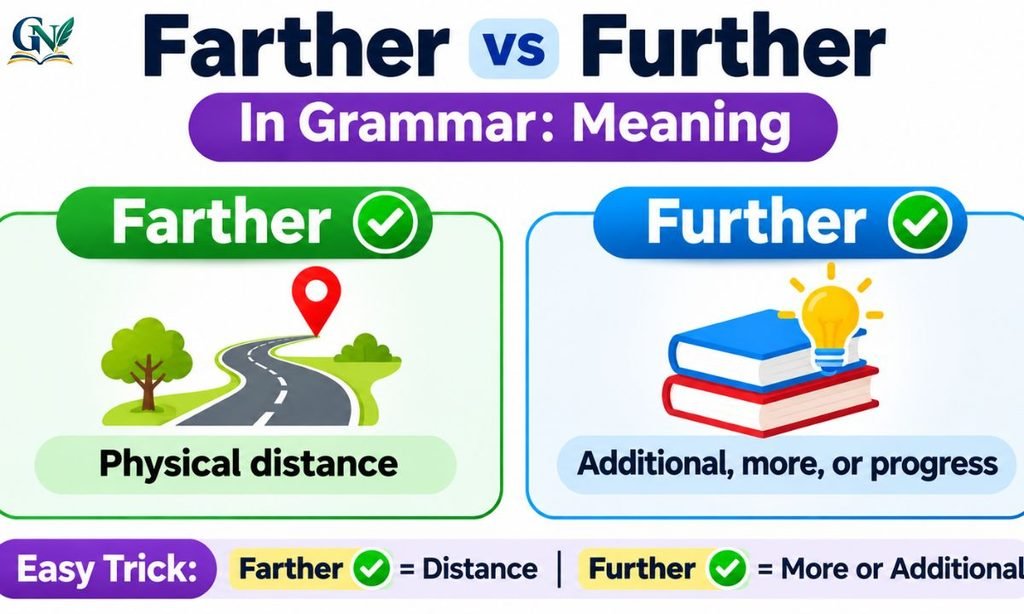
Use farther for distance you can measure and further for everything else. Further also works as a verb and as a stand in for “additional,” which farther never does.
| Word | Best use | Example |
| Farther | Measurable distance | The gas station sits two miles farther. |
| Further | Degree, extent, or “additional” | Do you need further help? |
| Further | Verb meaning “to advance” | A night course could further her career. |
Farther vs Further UK
British English accepts both words for distance, and further is the more common pick. Most UK writers don’t police the split the way American editors do. “It’s a mile further” reads as naturally as “it’s a mile farther” on a British page.
Further vs Farther Example
Short pairs show the split better than any rule.
- Physical: The cabin sits a mile farther up the trail.
- Figurative: Let’s discuss the budget further on Monday.
- Additional: The memo included further instructions.
- Verb: Volunteer work can further your career.
Farther vs Further Meaning
Farther means more distant in space. Further covers that sense and adds three more: to a greater extent, additional, and to help something advance.
Both words grew from the same family of older English forms, which explains the overlap. Many usage guides now tie farther to the idea of “far” and let further handle ideas.
Farther vs Further Along
Both phrases work, but the meaning shifts a little. “Farther along” usually describes a route, as in “The pharmacy is farther along this road.” “Further along” usually describes progress, as in “Our design is further along than the pilot.”
If you can picture a map, pick farther. If you picture a timeline or a checklist, pick further.
Farther and Physical Distance
Farther is the stronger choice when you can attach units to the gap. Miles, steps, floors, and meters all count. Garner’s Modern American Usage backs the same idea by assigning farther to physical distances.
Try a quick test. Ask “how much farther?” If a number like “three miles” answers it, you’ve found a physical measure. Compare: “Can you throw the ball farther than your brother?”
What Does Further Mean?
Further means to a greater degree, additional, or to advance something. It does three jobs that farther can’t touch.
As an adverb, it means “more”: “Let me explain further.” As an adjective, it means “additional”: “Any further questions?” As a verb, it means “to promote”: “She joined the board to further a cause.” It also opens sentences as a short cousin of furthermore: “Further, the report lacks dates.”
The Main Difference Between Farther and Further
Further has extra jobs that farther can’t do. Farther stays locked to distance, while further stretches to degree, addition, and action.
Here’s a handy check. Swap farther for further and the sentence usually survives. Swap the other way and it can break. “Farther discounts” and “farther your goals” both sound wrong.
Is Farther Only for Physical Distance?
In careful American usage, yes. Everyday speakers sometimes stretch it, as in “She got no farther with the puzzle than he did.” Editors may change that line, though most listeners won’t notice.
Even in loose speech, farther never carries the meaning “additional.” It also never works as a verb.
Farther vs Further for Distance
Most dictionaries accept either word when you describe distance, so your audience should guide the pick. American readers expect farther. British readers won’t blink at further.
Adjective and adverb forms follow the same pattern: “the farther shore,” “the further shore,” “farther away,” “further away.” With a mixed audience, further draws fewer complaints, though a strict American editor may still flag it.
Farther vs Further From the Truth
Further from the truth is the standard phrase. Truth isn’t a place on a map, so the figurative word fits. “That claim is further from the truth than anything he said last year.”
You’ll still see “farther from the truth” in print. An editor applying the usual rule would likely change it.
Farther vs Further in American English
American style guides generally reserve farther for physical distance and further for figurative distance. Newsroom and publishing rules, including AP style, lean this way.
Daily speech runs looser. Plenty of Americans say “further down the road” without a second thought, and the rule matters most in edited, professional writing.
Farther vs Further in British English
British usage treats the pair as near equals for distance and leans toward further. Dictionaries there still reserve further for “additional” and for the verb sense.
If you adapt British text for an American reader, check each further that points to distance. “The village is further than I thought” becomes “farther” in a strict US edit.
Farther vs Further Pronunciation
Farther echoes the word “car,” and further echoes the word “bird.” That vowel difference holds in both British and American speech.
British speakers don’t sound the r after a vowel, so the words land closer to “fah thuh” and “fuh thuh.” Americans pronounce every r, giving “FAR ther” and “FUR ther.”
Common Mistakes With Farther and Further
- Using farther for “additional,” as in “farther questions.” The correct word is further.
- Using farther as a verb, as in “farther your goals.” Only further works.
- Typing father when you meant farther. A spell checker won’t catch it.
- Splitting furthermore into “further more.” It’s one word.
- Using further for a measured mile in strict American copy. Farther fits better there.
Common Expressions With Further
Set phrases almost always choose further, never farther. These are the ones you’ll meet most often:
- Until further notice
- Without further ado
- Further to your message
- Go no further
- Further education
- On further reflection
A Simple Memory Trick
Spot the word “far” hiding inside farther. If you mean far away, use it.
For every other case, try swapping in “additional” or “furthermore.” If either fits, choose further. “Any additional questions?” works, so “any further questions?” is right.
Farther vs Further in Real-Life Writing
Real writing follows the same split most days. A few quick scenes:
- Email: “Please tell me if you need further details.”
- Fitness app: “You ran half a mile farther than last week.”
- Fiction: “The lights drifted farther into the fog.”
- Workplace note: “A new designer would further the project.”
Farther vs Further When Can Both Work?
Both words fit whenever you describe plain distance in relaxed speech. “Can you walk a bit farther?” and “Can you walk a bit further?” both sound fine to most ears, and British readers accept either.
Casual progress talk gets the same pass, as in “We’re farther along than I expected.” Formal American editing is where the strict split returns.
Practice Session Farther vs Further
Pick the right word for each blank.
- The hotel is two blocks ____ down the street.
- Do you have any ____ questions?
- This course should ____ your career.
- How much ____ do we have to drive?
- Nothing could be ____ from the truth.
Answers: 1 farther, 2 further, 3 further, 4 farther, 5 further. British English accepts either word in items 1 and 4.
Explore More Grammar Guide:
Dysregulated vs Disregulated: Meaning, Differences & Usage (2026)
Manuel or Manual: How to Use Each Word Correctly 2026
FAQ
Is it “farther away” or “further away”?
Both are accepted. American style prefers “farther away” for measurable distance, while British usage often picks “further away.”
Which word is safer when I’m unsure?
Further. It works for literal and figurative meanings, so it rarely counts as wrong.
Can farther ever mean “additional”?
No. Words like “additional” and “more” call for further, as in “further details.”
Is farther wrong in British English?
No. British readers understand it, though further appears more often.
Does the same rule apply to farthest and furthest?
Yes. Farthest suits physical distance, and furthest suits figurative distance or degree.

Abdul Rehman is a grammar enthusiast and content writer at Grammarnesty, dedicated to making English grammar, punctuation, sentence structure, and writing skills easy to understand.


Pingback: Ladel vs Ladle: Correct Spelling and Examples Explained 2026