
Manual is the word you want for anything done by hand and for any instruction booklet. Manuel is a first name. Swap one for the other in a sentence about a gearbox or a user guide and you’ve made a spelling error.
This guide separates the two words with plain definitions and real examples. You’ll also see why the mix-up happens and how to stop making it.
Quick Answer
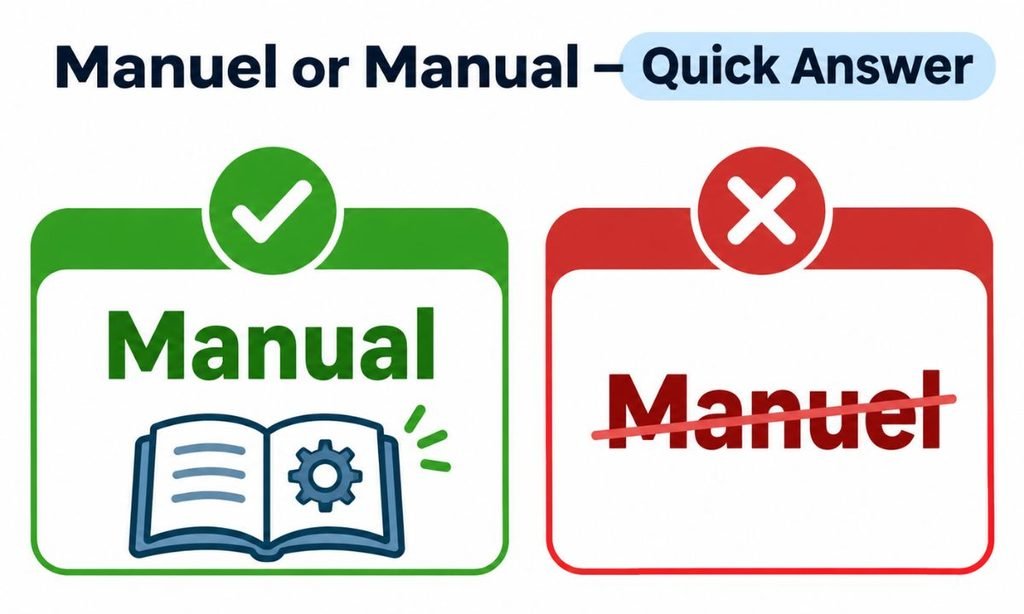
Use manual for anything done by hand or for an instruction booklet, as in “manual transmission” or “user manual.” Use Manuel only for a person’s name. Manuel has no English meaning beyond that, so it’s the wrong spelling in nearly every other sentence.
What Does Manual Mean?
Manual means done, operated, or controlled by hand instead of by a machine. It also names a book of instructions. The word works as an adjective and as a noun, and the spelling never changes.
Both senses come from the same Latin root, manus, which means “hand.” That root explains why the word shows up around tools, labor, and guidebooks.
Manual Meaning as a Noun
As a noun, a manual is a book that explains how to use, repair, or follow something. An owner’s manual rides in the glovebox. A training manual sits on a new hire’s desk.
The sense goes back to a small book you could carry in one hand. Dictionaries date this meaning to the 1530s. A less common noun sense is the hand-played keyboard on a pipe organ.
Manual Meaning as an Adjective
As an adjective, manual describes something performed by hand or by human effort. Manual labor, manual dexterity, and a manual gearbox all fit here.
It also separates a person-driven process from an automated one. A manual backup needs you to press the button. An automatic backup runs without you. The adverb form is manually.
What Does Manuel Mean?
Manuel is a masculine given name that means “God is with us.” It’s the Spanish and Portuguese form of Emmanuel, which comes from the Hebrew name Immanuel. That Hebrew form appears in the Book of Isaiah and is cited in the Gospel of Matthew.
Spanish speakers usually say it as mah-NWEL. Many English speakers say man-WELL. Common variants include Manolo and Manny. The feminine form is Manuela. Lin-Manuel Miranda is one well-known bearer of the name.
Is Manuel a Word in English?
No. Manuel is a proper noun in English, so it works as a name and nothing more. You won’t find an English definition of manuel that means “by hand” or “booklet.”
There’s a twist that explains the confusion. Manuel is a real common word in French, where it means manual. Middle English also borrowed it as manuel before the spelling settled into manual. In Spanish, manual is spelled exactly like the English word and the name Manuel stays separate. A rare given-name spelling, Manual, exists too, but it’s treated as a variant of Manuel.
Why Writers Confuse Manuel vs Manual

The two words share six of their letters and differ by one swapped vowel. That’s the perfect setup for a typo your eyes skip right over.
Spellcheck adds to the problem. Each word is valid on its own, so a checker has nothing to flag. Pronunciation helps the error along as well. Some speakers say Manuel in a way that sounds close to manual. Readers who also know French or Spanish may carry over a spelling from those languages.
Why Manuel Is Incorrect Spelling in Most Writing
Manuel is wrong in ordinary English because it has no meaning outside a person’s name. If your sentence describes a task, a tool, or a booklet, the correct spelling is manual.
Capitalization offers a quick clue. A name starts with a capital letter. A lowercase “manuel” inside an English sentence is almost always a typo. The exceptions are quoted French text and the name itself.
Situations Where Manual Is Used
Manual turns up wherever a person does the work instead of a machine. Three areas account for most of what you’ll read.
Technology and Software
In tech, manual describes steps you perform yourself. Examples include manual setup, manual backup, manual override, and manual data entry. The user manual is the noun form. If a program offers a manual mode and an automatic mode, the first one hands you the controls.
Automotive Industry
Cars use the word more than any other product. A manual transmission needs you to work a clutch pedal and shift gears yourself. The owner’s manual covers fluids, warning lights, and service schedules. Older cars may also have manual windows and manual locks.
Workplace Training and Documentation
Offices lean on manuals for consistency. An operations manual lists company procedures. A safety manual explains rules for a job site. Manual labor, meanwhile, describes work that relies on physical effort.
Manual vs Automatic Meaning
Manual means a person controls the action. Automatic means the system acts on its own. The two terms work as opposites in cars, cameras, software, and factory equipment.
Regional wording differs slightly for cars. Americans often say stick shift for a manual transmission and may call it a standard. British English tends to use manual.
Manuel vs Manual Examples in Sentences
Short examples make the split obvious. Read each one and ask whether it names a person or describes a thing.
Sentences Using Manuel
- Manuel is joining the design team on Monday.
- I asked Manuel for directions to the station.
- Our neighbor Manuel waters the garden every morning.
Sentences Using Manual
- The new blender comes with a manual in four languages.
- She prefers a manual camera because it gives her control.
- Switching the pump to manual mode took ten seconds.
- Manuel flipped through the repair manual before touching the engine.
The last sentence uses both words correctly. Manuel is the person. Manual describes the booklet.
A Small Spelling Error With Big Consequences
One wrong vowel can change a sentence into something odd. “Manuel transmission” reads like a gearbox with a first name. Typo jokes about mislabeled signs and product boxes are an easy target online.
The cost in professional writing is real. A mistake on a resume, a product page, or a work email can make readers doubt your care. Instructions suffer most. A mislabeled setting in a guide can confuse the very people it’s meant to help.
Easy Tricks to Remember the Correct Spelling
Link manual to its relatives. Manuscript, manufacture, and maneuver all share that hand-based root. Each one has an “a” after “manu,” and so does manual.
Check the ending next. Manual ends in “-al” like physical and digital. Manuel ends in “-el” like Samuel and Daniel, which are names too.
Finally, run a substitution test. If you can replace the word with “by hand” or “booklet,” use manual. If you can replace it with “Samuel,” use Manuel.
Why Correct Spelling Matters in Writing
Accurate spelling tells readers you checked your work. That trust matters whether you’re writing a blog post, a manual, or a message to a client.
Clean spelling also keeps meaning clear. A reader who has to stop and decode a typo loses the thread. Short words that look alike cause the most damage because nobody expects the slip.
Quick Manuel vs Manual Comparison
| Feature | Manual | Manuel |
| Type of word | Adjective and noun | Proper noun (given name) |
| Meaning | Done by hand, or an instruction book | “God is with us” |
| Capitalized? | Only at the start of a sentence | Always |
| Origin | Latin manualis, from manus (hand) | Hebrew Immanuel, via Spanish and Portuguese |
| Typical pronunciation | MAN-yoo-uhl | mah-NWEL |
| Example | Check the user manual. | Manuel called this morning. |
Other Common English Spelling Confusions
Manual and Manuel aren’t alone. These pairs trip up plenty of writers.
- Affect and effect: Affect is usually a verb. Effect is usually a noun.
- Complement and compliment: A complement completes something. A compliment is praise.
- Principal and principle: A principal is a head or main thing. A principle is a rule.
- Mantel and mantle: A mantel is the shelf above a fireplace. A mantle is a cloak or a role.
- Loose and lose: Loose means not tight. Lose means to misplace or fail to win.
Reference Cambridge Dictionary Definitions
Cambridge Dictionary treats manual as an adjective and as a noun. The adjective covers things done by hand, operated by a person, or needing physical effort. The noun covers a book of instructions for a machine, device, or procedure.
These senses match the entries in other major dictionaries. A name like Manuel belongs in a reference on given names instead. For the full wording and audio pronunciation, check the live Cambridge entry for manual.
Final Thoughts
Manual is the everyday word. It describes work done by hand and the booklet that tells you how to do it. Manuel is a person’s name with Hebrew roots and a meaning of “God is with us.”
Keep the substitution test handy. If a sentence needs “by hand” or “booklet,” write manual. If it needs a person, write Manuel.
Frequently Asked Questions
Is it manual or Manuel transmission?
It’s manual transmission. Manuel is a personal name and never describes a gearbox.
Is Manuel ever correct instead of manual?
Only when you mean a person named Manuel. In French text, manuel is also the real word for manual.
How do you pronounce manual?
Manual is pronounced MAN-yoo-uhl. Manuel is usually said mah-NWEL.
What is the opposite of manual?
The opposite is automatic. Manual needs a person to act, while automatic runs on its own.
What does the name Manuel mean?
Manuel means “God is with us.” It’s the Spanish and Portuguese form of Emmanuel, from the Hebrew Immanuel.

Abdul Rehman is a grammar enthusiast and content writer at Grammarnesty, dedicated to making English grammar, punctuation, sentence structure, and writing skills easy to understand.

Pingback: Dysregulated vs Disregulated: Meaning, Differences & Usage (2026)
Pingback: Farther vs Further: Meaning, Differences & Examples (2026)